




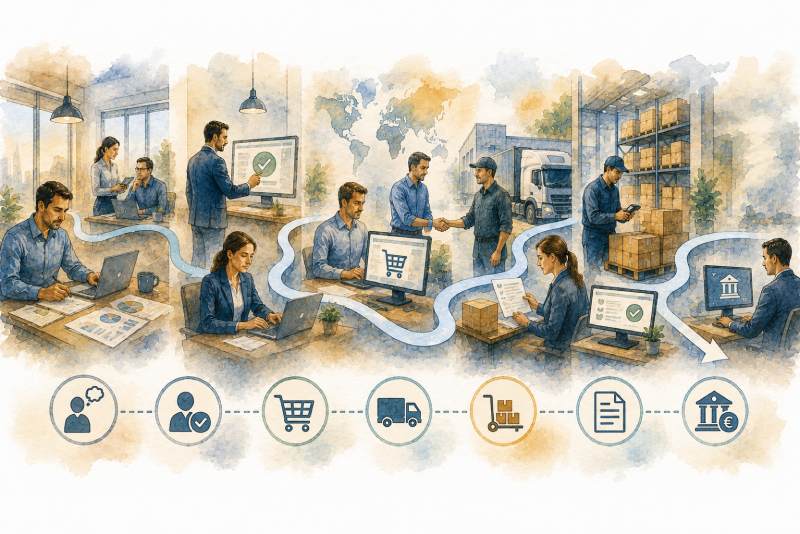
A P2P process connects a business requirement with approval, purchasing, delivery or service confirmation, invoice processing and payment. It creates an end-to-end workflow involving procurement, business functions, suppliers, goods receiving, finance and accounts payable. Organisations can improve the process by clarifying responsibilities, simplifying unnecessary steps, strengthening master data, reducing exceptions and using digital workflows where they add practical value.
An effective P2P process is more than a technical connection between a purchase order and an invoice. It represents the operational interaction between several business functions and influences how quickly requirements are fulfilled, how transparently expenditure is recorded and how efficiently supplier invoices can be processed.
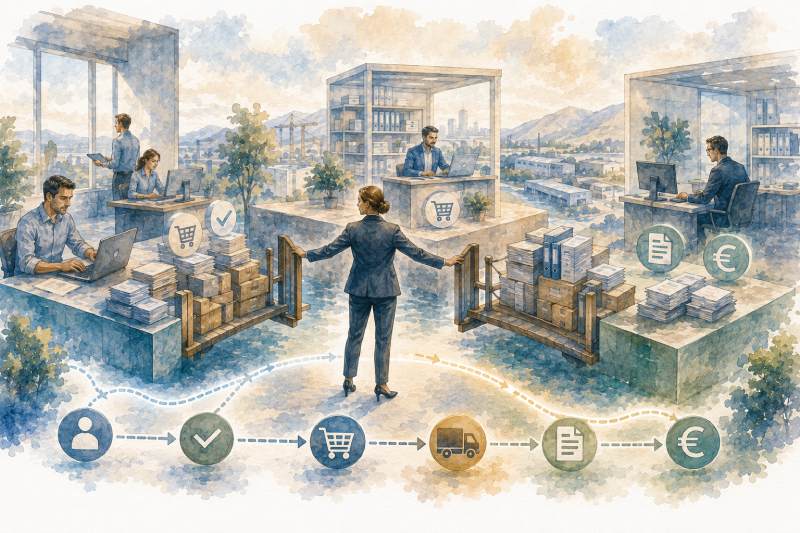
Many problems do not arise within one individual activity. They occur at the handover between functions. An incomplete purchase requisition delays approval. An unclear purchase order creates supplier queries. A missing goods receipt prevents invoice matching. An invoice without a purchase order creates additional work for procurement, finance and accounts payable.
Organisations seeking to optimise the procurement process should therefore avoid focusing exclusively on individual tasks or systems. Sustainable improvement requires an end-to-end view from the initial requirement through to payment and performance reporting.
What Is a P2P Process?
A P2P process is the complete procurement and payment workflow from the identification of a business requirement through to the payment of the supplier invoice.
P2P commonly stands for Procure to Pay or Purchase to Pay. The process links purchasing activities with invoice processing and financial settlement.
The Chartered Institute of Procurement & Supply describes procure to pay as the integration of purchasing and accounts processes. Core activities include purchase requisitions, purchase orders, receipt of goods or services and invoice processing.
A complete P2P process typically involves several functions:
- Business function: Defines the requirement, confirms the operational need and records receipt of the goods or services.
- Procurement: Manages purchasing routes, suppliers, contracts and purchase orders.
- Budget owner: Reviews the commercial requirement and approves the expenditure.
- Supplier: Confirms the order, supplies the goods or services and submits an invoice.
- Goods receiving or service recipient: Records what has been delivered or completed.
- Finance: Defines financial controls, accounting requirements and payment principles.
- Accounts payable: Processes invoices, investigates discrepancies and prepares approved invoices for payment.
- IT and process management: Support systems, integrations and digital workflows.
A well-designed process establishes a clear flow of information between these functions. Each participant should understand which activity they own, which information is required and what must happen before the next step can begin.
A clear organisation in procurement supports this process by defining responsibilities, decision paths and interfaces between operational and strategic activities.
Purchase to Pay and Procure to Pay: Is There a Difference?
Purchase to Pay and Procure to Pay are often used interchangeably, although the precise scope can vary between organisations and system environments.
Some organisations use Procure to Pay as a broader term that includes more activities before a purchase order is created. Others use both expressions for the same workflow from requisition through to payment.
There is no universally applied distinction. CIPS generally uses the term Procure to Pay, while enterprise system documentation may also refer to Purchase to Pay workflows covering purchase orders, receipts, invoices and payments.
For clarity, this article defines the Purchase to Pay process and Procure to Pay process as the following sequence:
- Identify and describe the requirement
- Create a purchase requisition
- Review and approve the requirement
- Select the supplier and purchasing route
- Create and issue the purchase order
- Record receipt of goods or completion of services
- Review and approve the invoice
- Complete payment
- Analyse procurement and process data
Strategic activities such as category strategy, long-term supplier development and sourcing strategy remain closely connected to P2P. However, they extend beyond the operational process covered in this article.
Which Steps Form Part of the P2P Process?
A complete P2P process connects operational demand, commercial approval, procurement execution and financial processing in one traceable workflow.
Identify the Requirement and Create a Purchase Requisition
Every procurement process begins with a business requirement.
The requesting function needs to describe which goods or services are required and provide enough information for procurement, approvers and suppliers to process the request efficiently.
A complete purchase requisition may include:
- a clear description of the requirement
- quantity or scope of work
- required delivery or completion date
- cost centre or project reference
- budget information
- procurement category
- delivery location
- operational contact
- known contract or supplier reference
Incomplete requirements often lead to queries and delays. At the same time, organisations should avoid adding excessive mandatory fields. Every requested data item should support approval, ordering, delivery, invoice processing or meaningful reporting.
Review and Approve the Requirement
An effective approval confirms that the requirement is operationally justified, financially understood and aligned with the organisation’s procurement rules.
Employees should be able to identify:
- who provides operational approval
- who owns the budget
- which approval limits apply
- when procurement involvement is required
- which delegation arrangements apply
- how urgent requirements are escalated
Too many approval stages can extend lead times without necessarily improving control. Approval rights that are too broad can reduce transparency and weaken governance.
A practical approval model considers the value, risk, procurement category and nature of the requirement.
Select the Supplier and Procurement Route
The appropriate procurement route should reflect the requirement, available contracts, approved suppliers and internal purchasing policy.
Before creating a new supplier, organisations should determine whether an existing approved source can meet the requirement.
Framework agreements, approved supplier lists and electronic catalogues can simplify purchasing when they are current, accessible and relevant to operational users.
Procurement may assess:
- available framework agreements
- existing contract coverage
- approved suppliers
- agreed commercial conditions
- supplier and supply risks
- sourcing or quotation requirements
- opportunities to consolidate demand
Effective supplier management provides the structures required to select, evaluate, develop and manage suppliers consistently.
Create and Issue the Purchase Order
The purchase order converts an approved requirement into a clear commercial instruction for the supplier.
It should contain the information required for delivery, service performance and subsequent invoice processing.
Relevant details may include:
- supplier information
- product or service description
- quantities
- agreed prices
- delivery dates
- delivery location
- payment and delivery terms
- purchase order number
- contract references
- operational and commercial contacts
A purchase order creates the greatest transparency when it is issued before delivery or the performance of a service.
A purchase order created retrospectively may record the transaction in the system, but it cannot fully perform its original approval and control function.
The supplier’s order confirmation should also form part of the workflow. Changes to quantities, prices or delivery dates should be identified and resolved before they become issues during receipt or invoice processing.
Record Goods or Services Received
Goods receipt and service confirmation provide evidence that the supplier has delivered what was ordered.
For physical goods, the process may include checks relating to:
- quantity
- delivery date
- visible damage
- delivery location
- quality requirements
Depending on the organisation, responsibility may sit with warehouse operations, logistics, the requesting function or quality management.
Services often require a different evidence model. The business function may need to confirm that defined activities, milestones or deliverables have been completed.
Not every purchase should therefore follow an identical receipt process. Standard materials, capital equipment, professional services and recurring service contracts require different forms of confirmation.
Review and Approve the Invoice
Invoice verification compares the supplier’s claim with the available order and receipt information.
A three-way match generally compares:
- the purchase order
- the goods receipt or service confirmation
- the supplier invoice
CIPS defines a three-way match as a comparison between the purchase order, invoice and goods received information. SAP documentation also describes three-way matching as invoice verification against both purchase order and receipt data.
Typical verification points include:
- supplier
- purchase order reference
- quantity
- price
- service scope
- receipt information
- accounting allocation
- payment terms
A discrepancy does not automatically indicate an error. Partial deliveries, agreed price changes or additional charges may be commercially justified.
The process should define who investigates each type of discrepancy, which tolerances apply and when escalation is required.
Not every purchase is suitable for the same matching process. For example, SAP documentation distinguishes two-way invoice matching for items that do not require a receipt.
Complete Payment and Analyse Process Data
Payment completes the financial transaction, but the resulting data should continue to support procurement and process management.
Following final approval, the invoice is recorded and paid in accordance with the agreed payment terms.
The resulting data can support:
- spend transparency
- supplier management
- contract analysis
- budget control
- procurement reporting
- process KPIs
- analysis of discrepancies and exceptions
End-to-end system visibility can connect requisitions with purchase orders, receipts, invoices and payments.
Where Do Typical Weaknesses Arise in the P2P Process?
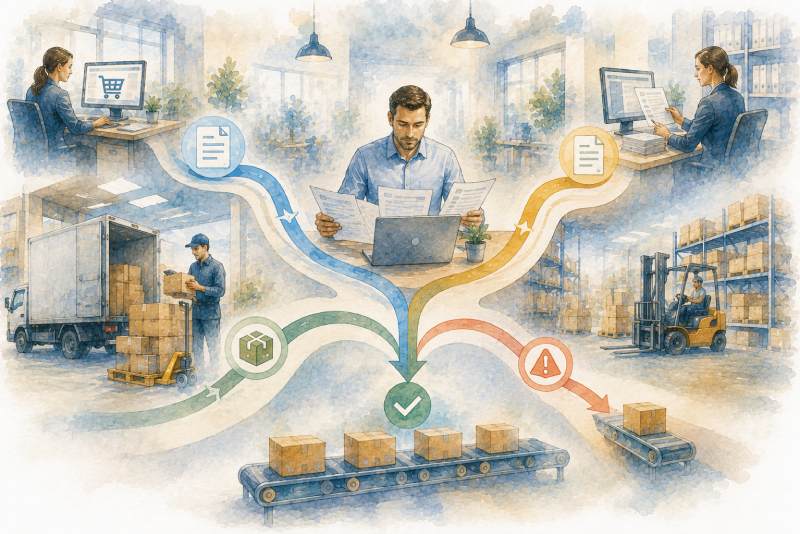
Most P2P problems arise at handovers between functions, within poorly controlled exceptions and where responsibilities are unclear.
| Process step | Typical weakness | Possible consequence | Potential improvement |
|---|---|---|---|
| Purchase requisition | Incomplete specification, missing cost centre or unclear required date | Queries, waiting time and inaccurate purchase orders | Clear mandatory fields and practical requisition standards |
| Approval | Too many approval stages or unclear delegation arrangements | Long cycle times and process avoidance | Risk-based approvals and clear escalation routes |
| Supplier selection | Supplier engagement without checking existing contracts | Lower contract utilisation and unnecessary supplier growth | Make approved suppliers and contracts easy to find and use |
| Purchase order | Purchase order created after delivery or completion of the service | Missing prior approval and additional investigation | Define purchase order requirements and practical exceptions clearly |
| Order data | Unclear quantities, prices or service descriptions | Supplier queries and later invoice discrepancies | Use purchasing standards and structured data fields |
| Goods receipt | Receipt is not recorded or is recorded late | Invoice cannot be matched reliably | Define ownership and expected recording times |
| Service confirmation | Completion of the service is not confirmed | Queries and delayed invoice approval | Define appropriate evidence for service procurement |
| Invoice | Invoice has no purchase order or buyer reference | Manual allocation and additional investigation | Communicate and validate reference requirements consistently |
| Invoice matching | Price or quantity discrepancy has no clear owner | Long resolution times and supplier queries | Define tolerances, responsibilities and escalation routes |
| Master data | Incorrect supplier, payment or accounting information | Errors, manual rework and limited reporting quality | Establish clear data ownership and maintenance processes |
| End-to-end process | Email approvals, system breaks and parallel purchasing routes | Duplicate work, limited transparency and weak control | Reduce process variants and integrate workflows |
Local improvements alone may not address the underlying issue.
Automating invoice processing does not resolve incomplete purchase orders or missing receipt information. Accelerating approvals does not improve an unclear requirement specification.
The process needs to be managed as one connected workflow.
Why Interfaces Between Procurement, Business Functions and Finance Are Critical
A P2P process only works when all participating functions accept common rules, responsibilities and process objectives.
Business functions usually prioritise speed and operational availability. Procurement requires visibility, contract utilisation and appropriate supplier control. Finance focuses on budget, accounting accuracy and financial governance. Accounts payable requires complete and verifiable invoice information.
These objectives are not inherently contradictory. Problems arise when they are not translated into a practical shared process.
Role of Business Functions
Business functions define requirements and retain operational responsibility.
They should submit complete information at an appropriate time and confirm receipt of goods or services promptly.
Role of Procurement
Procurement defines purchasing routes, manages contracts and suppliers and connects operational requirements with strategic objectives.
The relationship between operational and strategic procurement is particularly important. Operational procurement manages day-to-day execution, while strategic procurement establishes supplier structures, commercial frameworks and longer-term priorities.
Role of Finance and Accounts Payable
Finance establishes financial controls, accounting principles and budget requirements.
Accounts payable processes supplier invoices and often identifies weaknesses in earlier stages of the workflow. Missing purchase orders, incorrect accounting information and absent receipt confirmations become visible during invoice processing.
These issues should not be treated only as accounts payable problems. They often indicate weaknesses further upstream.
Role of Goods Receiving and Service Recipients
Goods receiving and operational service recipients confirm what has actually been delivered.
Without this information, invoice approval may lack essential evidence.
Shared Process Objectives
Useful shared objectives may include:
- practical purchasing routes
- controlled cycle times
- complete order information
- fewer avoidable exceptions
- transparent approved exceptions
- timely invoice approval
- reliable procurement and financial data
A shared process perspective also reduces unproductive blame between functions.
The relevant question is not simply which department made an error. The more useful question is where the workflow needs to be improved.
P2P Process Optimisation: The Most Important Measures
P2P process optimisation is most effective when organisations first understand the real workflow and then improve responsibilities, data, rules and technology together.
Understand the Current Process First
Begin with the actual process rather than the documented ideal.
Review:
- Which process variants exist?
- Where are emails or spreadsheets used?
- Which approvals take place outside the main system?
- Which exceptions occur repeatedly?
- Where do users need additional clarification?
- Which activities are performed more than once?
- Where is ownership unclear?
Recurring exceptions are particularly valuable sources of information. They show where the standard process does not meet operational needs or is not being used as intended.
Simplify Approvals
Approvals should provide appropriate control without creating unnecessary waiting time.
Consider:
- Is every approval stage required?
- Are approval limits realistic?
- Are operational and budget approvals clearly distinguished?
- Do effective delegation arrangements exist?
- Can standard purchases follow a simpler route?
- Are escalation procedures clear?
Risk-based approval models can treat different types of purchase appropriately.
A recurring catalogue order may not require the same workflow as a new supplier, significant capital expenditure or a complex professional service.
Standardise Purchase Requisitions
A good purchase requisition provides the information required for action without overwhelming users.
Relevant mandatory information may include:
- procurement category
- cost centre
- budget reference
- delivery date
- quantity
- operational specification
- delivery location
- requesting contact
A mandatory field only improves data quality when users understand what information is expected and why it is required.
Make Suppliers and Contracts Easier to Use
Approved suppliers and framework agreements need to be accessible during day-to-day purchasing.
Useful measures include:
- current approved supplier information
- electronic catalogues
- clear contract guidance
- practical service descriptions
- named points of contact
- regular review of contract coverage
Strategic procurement establishes the supplier and commercial framework. The P2P process must make that framework usable in operational purchasing.
Improve Master Data
Poor master data can create errors across several stages of the process.
Relevant data areas include:
- supplier master data
- product and service data
- accounting information
- cost centres
- payment details
- tax information
- procurement categories
- contract references
Organisations should define:
- Who may create master data?
- Who reviews changes?
- Who owns data quality?
- How are duplicates identified?
- How are obsolete records reviewed or deactivated?
Data quality is not a one-off cleansing activity. It requires continuing ownership and governance.
Use Digital Workflows Purposefully
Digital workflows can route requisitions, approvals, purchase orders and invoices through a structured process.
Potential functions include:
- digital purchase requisitions
- rules-based approvals
- automated routing
- status visibility
- catalogue purchasing
- electronic purchase orders
- digital goods receipt
- electronic invoice processing
- automated matching
- escalation notifications
- process reporting
Technology should not reproduce an inefficient process without challenge.
An unnecessary approval stage remains unnecessary when it is moved into a digital workflow.
Reduce Invoices Without Purchase Orders
Invoices without a purchase order frequently indicate that purchasing took place before the approved process was completed or that a procurement route does not reflect the practical requirement.
Relevant measures include:
- clear purchase order requirements
- defined exceptions
- suitable processes for service procurement
- earlier involvement of procurement
- communication with business functions and suppliers
- analysis of recurring causes
- transparent reporting by function and category
Electronic invoice standards can carry structured order references. Peppol documentation states that an invoice must contain a buyer reference or purchase order reference, and that an existing purchase order number should be provided as the order reference.
Technical references only help when the purchase order has been created in time and communicated correctly.
Analyse Exceptions Systematically
Exceptions and invoice queries provide valuable information for process improvement.
Recurring causes may include:
- missing purchase order
- absent goods receipt
- missing service confirmation
- price discrepancy
- quantity discrepancy
- incorrect accounting allocation
- incomplete supplier data
- unclear approved exception
Each recurring cause should have an owner, a corrective action and a defined method of monitoring progress.
Which KPIs Are Useful for the P2P Process?
P2P KPIs should answer specific management questions and reflect the organisation’s process maturity and data quality.
| KPI | What it indicates | Possible data source | Potential misinterpretation |
|---|---|---|---|
| Purchase requisition approval time | Time between submission and full approval | Workflow or ERP data | A short approval time does not confirm the quality of the decision |
| Time from requisition to purchase order | Total processing time before the order is created | E-procurement or ERP system | Complex sourcing activities should not be compared directly with catalogue orders |
| Purchases through defined processes | Use of approved procurement channels | ERP, procurement system and spend analysis | Approved exceptions need to be assessed separately |
| Invoices with a purchase order reference | Proportion of invoices that can be linked directly to an order | Invoice workflow or accounts payable system | A reference does not confirm that the purchase order data is complete or accurate |
| Invoices without a purchase order | Potential gaps in purchasing discipline or process coverage | Accounts payable and ERP data | Approved exceptions should not automatically be treated as non-compliance |
| Automatically processed invoices | Proportion processed without manual intervention | Invoice processing system | A high automation rate is not proof of overall process quality |
| Number or proportion of exceptions | Discrepancies and additional processing requirements | Workflow, ticketing or invoice data | Without cause classification, the KPI provides limited management insight |
| Invoice approval time | Waiting time between invoice receipt and final approval | Invoice workflow | Delays may originate from missing orders or receipt information |
| Contract utilisation | Use of existing framework agreements | Contract management and spend analysis | Existing contracts may not cover every requirement appropriately |
| Use of approved suppliers | Alignment with the defined supplier structure | Supplier master data and procurement transactions | Approved status does not confirm current supplier performance |
| Process cost | Internal effort associated with selected process variants | Activity, time and cost data | Weak data can create misleading precision |
KPIs should support action rather than reporting alone.
For example, a high automation rate is not automatically positive. Automating incomplete or inaccurate data does not necessarily improve the overall process.
A focused set of procurement KPIs can provide useful visibility, while effective procurement controlling connects performance information with priorities and management decisions.
What Role Does Digitalisation Play in P2P Optimisation?
Technology can accelerate a well-designed process, but it cannot replace clear organisation, responsibilities or data ownership.
Digital procurement can support:
- electronic purchase requisitions
- automated approval routing
- electronic catalogues
- rules-based purchasing
- digital receipt confirmation
- electronic invoices
- automated matching
- workflow management
- status information
- integrated reporting
The benefits depend on several foundations:
- clear process rules
- reliable master data
- defined responsibilities
- appropriate system integration
- practical user experience
- controlled exception processes
A new system does not automatically resolve fragmented responsibilities or inconsistent processes.
Where sites, legal entities or business functions follow different procedures, those variants should be understood before they are transferred into one platform.
Digitalisation should therefore begin with business process analysis. The organisation can then determine which activities should be standardised, automated or deliberately remain flexible.
P2P Process and Maverick Buying
An impractical P2P process can contribute to maverick buying because users may create alternative purchasing routes when the approved process does not meet operational needs.
Maverick buying refers to procurement outside defined purchasing routes, approvals, suppliers or contracts.
Examples may include:
- direct supplier engagement without procurement involvement
- orders outside approved systems
- purchases from non-approved suppliers
- use of suppliers outside existing contracts
- invoices submitted without a prior purchase order
Common connections include:
- lengthy approvals encourage direct purchasing
- missing catalogue items lead users to alternative suppliers
- unclear responsibilities result in individual solutions
- difficult systems reduce process adoption
- limited contract visibility leads to off-contract purchasing
Rules and prohibitions alone do not resolve these causes.
Organisations should investigate why the approved process is not being used. The cause may be limited awareness, but it may also be an unsuitable workflow, missing purchasing options or poor system usability.
The objective should be to make compliant purchasing both controllable and practical.
How Can Organisations Optimise the Procurement Process Step by Step?
Procurement process optimisation should begin with transparency and then focus on the most important causes of delay, rework and weak control.
1. Map the Current Process
Document the actual workflow from requirement through to payment.
Include standard routes, manual activities and recurring exceptions.
2. Analyse Data and Exceptions
Review relevant information such as:
- approval times
- invoices without purchase orders
- recurring invoice discrepancies
- contract utilisation
- delayed goods receipts
- repeated manual interventions
3. Prioritise Interface Problems
Identify the handovers that create the greatest operational effort.
Common examples include the interface between the requesting function and procurement or between service confirmation and invoice approval.
4. Clarify Roles and Responsibilities
Define for each process stage:
- the responsible operational role
- decision ownership
- approval responsibility
- delegation arrangements
- escalation routes
5. Simplify Approvals
Remove unnecessary loops and align approval limits with value, risk and procurement category.
6. Improve Master Data
Prioritise the data fields that create the highest level of error, rework or reporting limitations.
7. Define a Pilot Process
Begin with a selected business area, procurement category or process variant.
A focused pilot allows the organisation to validate responsibilities and workflows before wider implementation.
8. Select Appropriate Digital Support
Assess systems against the required business process.
Technology should support the target process rather than determine it without operational analysis.
9. Define Process KPIs
Select a limited number of measures linked to specific improvement objectives.
10. Involve Employees
Engage procurement, business functions, finance, accounts payable and operational users early.
Process adoption depends on understandable workflows and practical benefits.
11. Monitor Implementation
Review whether the new process is being used and identify any new forms of exception or manual work.
12. Continue to Develop the Process
P2P optimisation is not completed when a system goes live.
Changes in organisational structure, supplier arrangements and procurement requirements may require regular adjustment.
Common Mistakes in Procurement Process Optimisation
Many improvement programmes struggle because technology is introduced before process ownership, responsibilities and priorities have been clarified.
Selecting Software Before Defining the Process
A new platform is selected before the target process has been agreed.
Existing weaknesses are then reproduced within the new technology.
Pursuing Too Many Objectives at Once
The organisation attempts to improve automation, cycle time, data quality, compliance and system harmonisation simultaneously.
Without prioritisation, implementation loses focus.
Excluding Business Functions
The process is designed solely from the perspective of procurement or finance.
Operational requirements and user experience are not addressed.
Creating Overly Complex Approvals
Additional controls create new waiting times and encourage users to seek alternative purchasing routes.
Leaving Responsibilities Unclear
Ownership remains uncertain for master data, exceptions, supplier queries or overall process performance.
Neglecting Master Data
Digital workflows are implemented while essential supplier, product or accounting data remains unreliable.
Failing to Define Exceptions
Special cases continue to be resolved informally, creating parallel processes and limited transparency.
Using KPIs Without Management Ownership
Performance measures are reported, but no one is responsible for reviewing causes or implementing corrective action.
Underestimating Communication
Employees receive new instructions without a clear explanation of responsibilities, practical steps or expected benefits.
Lacking End-to-End Process Ownership
Individual departments optimise their own activities without considering the impact on the overall workflow.
When Is External Support Useful for P2P Optimisation?
External support can be useful when internal capacity is limited, ownership is unclear or improvement requires coordinated implementation across several functions.
Typical situations include:
- a high number of process variants
- multiple sites or legal entities
- recurring escalation between procurement and finance
- extensive manual invoice investigation
- introduction of a new procurement platform
- organisational restructuring
- missing end-to-end process ownership
- urgent operational or financial pressure
- limited connection between process design and implementation
Not every process improvement requires external support.
Smaller changes can often be delivered internally when responsibilities, data and resources are available.
External support may become relevant where an independent assessment, cross-functional coordination or additional implementation capacity is required.
Where leadership and execution capacity are needed at short notice, interim management in procurement can connect process improvement with operational responsibility.
Conclusion: A Good P2P Process Connects Speed, Control and Transparency
An effective P2P process connects requirements, approval, purchasing, delivery, invoicing and payment within one manageable workflow.
The greatest improvement opportunities are often not found in one system activity. They arise at interfaces, within manual handovers and across recurring exceptions.
Organisations seeking to optimise the procurement process should consider the following elements together:
- clear roles and responsibilities
- complete and practical purchase requisitions
- proportionate approval processes
- accessible contracts and supplier structures
- accurate purchase order information
- reliable goods receipt and service confirmation
- high-quality master data
- appropriate digital workflows
- focused management KPIs
Technology can support these improvements, but it cannot replace an effective procurement organisation or shared process ownership.
A strong Purchase to Pay process does more than improve control. It simplifies day-to-day procurement, supports collaboration between procurement, business functions and finance and provides a more reliable basis for transparency and decision-making.
Current Insights on LinkedIn
If you regularly deal with topics such as procurement, supply chain, interim management and cost optimisation, you can find further insights, perspectives and practical examples from SJL Management & Consulting on LinkedIn.
FAQ
What Is a P2P Process?
A P2P process describes the full workflow from purchase requisition and approval through supplier selection, purchase ordering, receipt of goods or services, invoice verification and payment. It connects procurement, business functions, suppliers, finance and accounts payable in one end-to-end purchasing and financial process.
What Is the Difference Between Purchase to Pay and Procure to Pay?
Purchase to Pay and Procure to Pay are often used interchangeably. The precise scope may vary between organisations and system models. A clear internal definition is therefore important. In this article, P2P covers the complete workflow from the identification of a requirement through to payment and process reporting.
Which Steps Form Part of the P2P Process?
Typical P2P activities include requirement definition, purchase requisition, approval, selection of the procurement route, purchase ordering, supplier confirmation, goods receipt or service confirmation, invoice verification, payment approval and payment. The resulting data can then support procurement reporting, supplier management and process improvement.
How Can an Organisation Optimise Its Procurement Process?
Begin by mapping the actual process and analysing recurring exceptions. Organisations can then clarify responsibilities, simplify approvals, standardise purchase requisitions and improve master data. Digital workflows should support the agreed target process, while selected KPIs should make delays, discrepancies and process adoption visible.
What Roles Do Procurement and Finance Play in the P2P Process?
Procurement manages purchasing routes, suppliers, contracts and purchase orders. Finance defines financial controls, budget requirements and accounting principles. Accounts payable processes supplier invoices and identifies many process discrepancies. An effective P2P process therefore requires shared rules and clearly defined handovers between these functions.
Which KPIs Are Useful for the P2P Process?
Relevant KPIs may include purchase requisition approval time, time from requisition to purchase order, invoices without purchase orders, invoice exception rates, invoice approval time and contract utilisation. The measures should reflect the organisation’s process maturity and data quality. A high automation rate alone does not demonstrate an effective process.
Make Your P2P Process Clearer and More Effective
Are you seeking to analyse your P2P process, improve interfaces between procurement, business functions and finance or reduce recurring invoice queries?
SJL Management & Consulting supports organisations in assessing procurement processes, prioritising relevant weaknesses and implementing practical improvements. The focus is on clear responsibilities, usable workflows, reliable data and procurement structures that connect operational requirements with effective control.