




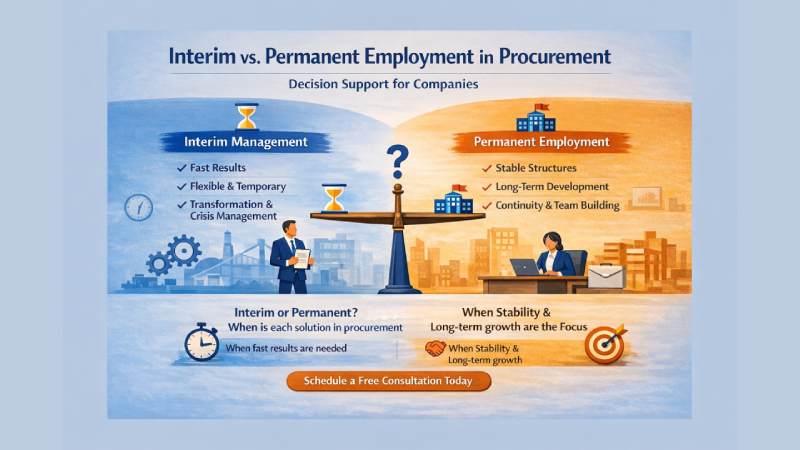
In which situations is interim management in procurement the better solution – and when is permanent employment the right choice?
The decision between interim management and permanent employment in procurement depends primarily on time pressure, the need for change and the objectives to be achieved. Interim management is suited to rapid impact and transformation, while permanent roles are designed for long-term stability and development.
The choice between interim and permanent employment is one of the key strategic decisions in procurement. It is rarely a purely organisational issue. In most cases, it is about time pressure, the need for change, responsibility for results and the question of how quickly impact must be delivered. This is precisely why the question “interim vs permanent employment in procurement” cannot be answered in a generalised way.
This article provides a structured decision guide. It shows when an interim assignment is appropriate, when a permanent appointment is the better solution, and which criteria are decisive in making the right choice.
Why the Question of Interim or Permanent Employment in Procurement Matters
Procurement today is under greater pressure than many other functions. Cost, risk, security of supply and strategic contribution are demanded simultaneously. In such situations, it quickly becomes clear whether existing structures are sufficient or whether temporary reinforcement is required.
The question “interim or permanently employed Head of Procurement” typically arises when:
- short-term responsibility for results must be assumed
- strategic clarity is lacking
- leadership capacity is insufficient
- change is difficult to implement internally
This decision concerns not only the filling of a role, but the way leadership and change are shaped within procurement.
Interim Management vs Permanent Employment: Fundamental Differences
When comparing interim management vs permanent employment, the issue is less about cost and more about impact and time. Both models serve different purposes.
Permanent employment is designed for continuity. It is suitable for stable structures, long-term capability building and sustainable organisational development.
Interim management is designed for impact within a limited period. It is used when rapid clarity, execution power and independence are required.
The difference lies not in capability, but in deployment context.
Quick Decision: Interim or Permanent in Procurement?
Interim management when rapid impact is required, acute pressure exists, or structures and priorities need to be realigned.
Permanent employment when stability, long-term capability building and continuous development are the main focus.
When Interim Management in Procurement Makes Sense
The question of when interim management makes sense can be answered clearly when certain conditions are present.
Typical deployment scenarios include:
- acute earnings or cost pressure
- vacancies in key positions
- necessary realignment of procurement strategy or organisation
- blockages caused by internal interests or structures
- lack of time for induction
In these situations, an interim assignment brings speed and focus. Decisions are taken, not postponed. Measures are implemented, not merely prepared.
Interim or Permanent Head of Procurement: A Leadership Question
At executive level in particular, the trade-off is especially relevant. A permanently employed Head of Procurement becomes a long-term part of the organisation. They develop teams, build relationships and shape culture.
An interim Head of Procurement, by contrast, assumes responsibility for a limited period. Their mandate is clearly defined. They are not measured by tenure, but by results.
An interim assignment is particularly appropriate when:
- structures need to be reorganised
- difficult decisions are pending
- neutrality is required
- the organisation needs temporary relief
After this phase, a permanent appointment may follow – or the decision may be consciously reassessed.
When Permanent Employment in Procurement Is the Better Choice
Permanent employment is appropriate when stability and continuity are the priority. This applies in particular when:
- the procurement organisation is established
- no acute crisis exists
- long-term capability building is required
- cultural integration is important
In these cases, permanent employment offers greater sustainability than a temporary assignment.
Cost Perspective: Expensive in the Short Term, Effective in the Long Term
Interim management is often perceived as expensive. This view is too narrow. What matters is not the daily rate, but the economic effect.
Interim assignments are time-limited, do not create long-term fixed costs and are aimed at measurable impact. Permanent employment entails lower ongoing costs, but its impact unfolds more slowly.
The economically right decision depends on context, not on the hourly rate.
Typical Wrong Decisions in Interim vs Permanent Employment
In practice, recurring patterns lead to suboptimal decisions:
- interim is used even though long-term leadership is lacking
- permanent employment is chosen despite acute pressure to act
- roles and expectations are not clearly defined
- decisions are made from a cost perspective instead of an impact perspective
A sound assessment avoids precisely these mistakes.
Interim as a Bridge, Not a Substitute
Interim management is not a substitute for permanent employment. It is a bridge. A bridge over vacancies, crises or transformation phases.
In many successful projects, an interim assignment is followed by a structured permanent appointment. The difference: the organisation is clearer, more stable and better positioned afterwards.
Conclusion: Interim or Permanent Is Decided by Context
The question of interim vs permanent employment in procurement cannot be answered in general terms. It depends on objectives, time, pressure and the need for change.
Interim management is appropriate when rapid impact, clarity and execution are required. Permanent employment is the right choice when stability, development and continuity are the priority.
Those who use these differences consciously make better decisions and avoid costly misappointments.
Whether interim management or permanent employment – the right choice depends on context. In a non-binding conversation, we clarify together which solution makes sense for your current procurement situation and how quickly impact can be achieved.
FAQ: Interim vs Permanent Employment in Procurement
When is interim management in procurement appropriate?
When there is time pressure, vacancies, performance problems or a need for change.
What distinguishes interim management from permanent employment?
Interim is time-limited and impact-oriented; permanent employment is designed for continuity.
Is an interim Head of Procurement only a temporary stopgap?
No. Interim assignments often create the foundation for sustainable structures.
When is permanent employment in procurement the better option?
In stable organisations without acute need for change.
Can interim management prepare a permanent appointment?
Yes. Interim is often deliberately used as a bridge to a later permanent placement.