


When companies face procurement challenges, they frequently ask: Do we need a consultancy or an Interim Procurement Leader? Both approaches promise support and bring external expertise. In practice, however, they differ fundamentally in role, accountability and effectiveness.
In time-critical situations, leadership gaps or escalations, this decision directly influences pace, performance pressure and sustainability of results.
Two Models, Two Logics
At first glance, interim procurement management and traditional procurement consultancy pursue similar objectives: improving processes, reducing costs and mitigating risk. Yet their paths to achieving these objectives differ considerably.
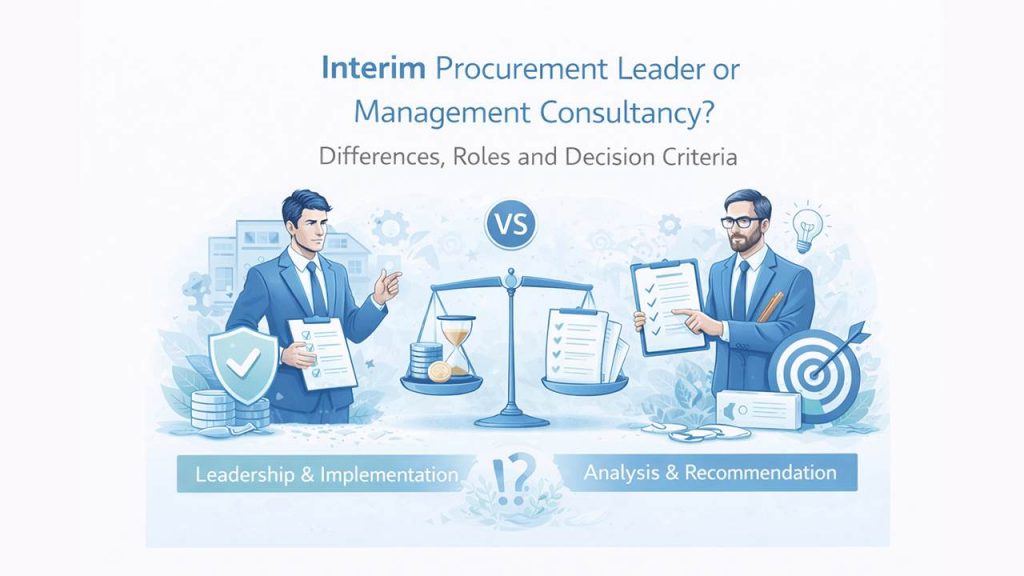
The core distinction lies in the role itself. Consultancy is based on recommendation; interim leadership is based on responsibility.
Role Definition: Accountability versus Recommendation
An Interim Procurement Leader works directly within the organisation. He or she assumes an operational leadership role, forms part of the management structure and carries responsibility for decisions and outcomes. Interim procurement management means not only analysing but implementing.
A management consultancy in procurement, by contrast, typically operates from the outside. It analyses, structures, evaluates and delivers recommendations. Implementation usually remains with the organisation.
The difference is fundamental:
- Interim Procurement Leaders assume responsibility
- Consultants provide recommendations
Both roles are legitimate — the decisive factor is the specific situation.
Integration into the Organisation
An Interim Procurement Leader is embedded within the organisation. He or she leads teams, moderates conflicts, makes day-to-day decisions and carries accountability for results. This ensures proximity to operational reality.
Consultancy, by contrast, typically operates in clearly defined projects. The focus lies on analysis, design and the development of measures. Operational integration is intentionally limited.
In tense or unstable situations, this difference is critical. Leadership presence and immediate decision-making cannot be replaced by conceptual work alone.
Speed and Performance Pressure
Interim procurement management is designed to deliver impact under time pressure. Assignments often begin when rapid decisions are essential — due to vacancies, escalations or acute cost pressure.
An Interim Procurement Leader:
- Prioritises immediately
- Makes binding decisions
- Implements measures directly
- Is measured against results
Consultancy projects require preparation time. Data must be collected, interviews conducted and analyses aligned. This creates structure — but it consumes time.
When speed is decisive, interim procurement offers clear advantages.
Cost Structure and Impact Logic
The economic logic of both models also differs. Consultancy is usually project-based and compensated independently of implementation success. Impact only materialises once the organisation executes the recommendations.
Interim procurement management follows a different logic. The assignment is time-limited, transparent in cost and directly linked to operational impact. Savings, stabilisation and measurable improvements occur during the mandate.
Typical features of interim assignments:
- Clear daily or monthly rates
- Direct accountability for outcomes
- Measurable effects during the engagement
Particularly in cost optimisation initiatives, this distinction is significant. Impact arises from execution — not from analysis alone.
Typical Scenarios for an Interim Procurement Leader
Interim Procurement Leaders are particularly valuable when leadership is absent or when rapid impact is required. Typical scenarios include:
- Vacancy at Head of Procurement level
- Escalating supplier relationships
- Acute cost or margin pressure
- Transformation programmes under time pressure
- Insufficient internal capacity for implementation
In such cases, consultancy alone is often insufficient.
Typical Scenarios for Procurement Consultancy
Consultancy is appropriate when strategic or conceptual questions dominate, or when an external perspective is required, for example:
- Strategic repositioning of procurement
- Benchmarking and market analysis
- Organisational and process design
- Long-term transformation programmes
Here, consultancy can provide valuable impulses — provided the organisation has the capacity to implement them.
Interim Procurement and Consultancy: Not Either-Or
In practice, the two approaches are not mutually exclusive. A combination can be highly effective. Consultancy delivers structure and concepts; interim procurement ensures implementation and sustainable embedding.
The decisive factor is clear separation of roles. Interim procurement management does not replace strategy work, and consultancy does not replace leadership.
Decision Criteria for Organisations
The key question is not “Which is better?”, but “What do we need now?”
Critical considerations include:
- Is there acute time pressure?
- Is operational leadership in procurement missing?
- Must decisions be implemented immediately?
- Is the focus on stabilisation or conceptual redesign?
The clearer these questions are answered, the clearer the decision becomes.
Our Understanding of Interim Procurement Management
At SJL Management & Consulting, we view interim procurement management as operational leadership on a temporary basis. We assume responsibility, integrate into the organisation and deliver measurable results.
Our focus lies on execution, impact and sustainability — particularly where traditional consultancy reaches its limits.
Making the Right Decision
If you are currently evaluating whether an Interim Procurement Leader or management consultancy is the right solution, speak to us. In a non-binding conversation, we will clarify which model best fits your situation — and why.
+49 (0) 89 910 49 402
info@sjl-mc.com
FAQ: Interim Procurement Leader vs. Management Consultancy
When is an Interim Procurement Leader more appropriate than consultancy?
In situations of time pressure, leadership vacancies or where implementation and operational direction are required.
Can interim procurement replace consultancy?
No — but it complements consultancy where operational impact is necessary.
Is interim procurement suitable for large organisations?
Yes, particularly in complex structures with high performance pressure.
How quickly does interim procurement deliver results?
Often within weeks, as decisions are implemented directly.
Can consultancy and interim be combined?
Yes — provided roles and responsibilities are clearly defined.