



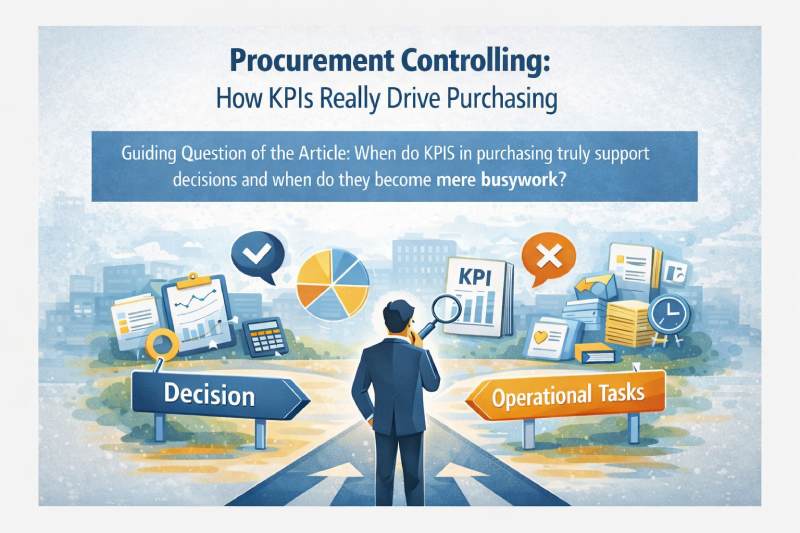
When do KPIs in procurement genuinely support decisions – and when do they become little more than busywork?
Procurement controlling supports management decisions in procurement by using relevant KPIs in a targeted way to steer priorities, risks and deviations from objectives. It differs from pure KPI reporting through its focus on decision readiness rather than data depth.
In many organisations, procurement controlling exists, but it does not steer. KPIs are collected, reports distributed, dashboards maintained. Yet the impression remains that decisions hardly change. Priorities continue to emerge from day-to-day operations or individual opinions, not from robust steering impulses.
This is precisely where a change of perspective is worthwhile. Procurement controlling creates value not through completeness, but through relevance. Not through many numbers, but through a few, well-chosen decision anchors.
Why Procurement Controlling Often Fails to Steer
In practice, a recurring pattern emerges. Companies invest a great deal of time in collecting procurement controlling KPIs without first clarifying what they are actually meant to be used for. The result is extensive KPI sets that suggest transparency but provide no direction.
Typical symptoms include:
- KPIs are reported regularly, but rarely discussed
- Deviations remain without consequences
- Management asks about individual cases instead of trends
- Decisions are made independently of the reporting
The problem lies not in the KPIs themselves, but in the lack of a steering logic behind them.
When KPIs in Procurement Controlling Are Meaningful
KPIs deliver value whenever there is a genuine decision question behind them. Procurement controlling is not an end in itself, but an instrument to support trade-offs.
Typical situations in which KPIs in procurement controlling create real added value are:
- Prioritising commodity groups or initiatives
- Assessing risks and dependencies
- Weighing cost against security of supply and flexibility
- Steering supplier relationships at management level
In all these cases, the focus is not on exact figures, but on comparability, trends and decision readiness.
Procurement Controlling KPIs: Measure Less, Decide More
A common mistake is trying to make as many aspects measurable as possible. This causes procurement controlling to lose clarity. What matters is not the number of KPIs, but their function.
Each KPI should answer a clear question, for example:
- Where are we deviating from the planned course?
- Where is action required?
- Where do priorities need to be adjusted?
KPIs that do not prepare a decision do not belong in active procurement controlling.
Measurable Goals in Procurement as a Prerequisite
Without clear target states, every KPI remains open to interpretation. Measurable goals in procurement are therefore not an addition, but a prerequisite for effective controlling.
The focus is less on ambitious target levels than on clarity. A goal must be formulated in such a way that it is clear:
- what is being steered towards
- within which time frame
- with what priority
Only then can KPIs be meaningfully interpreted. Without this clarity, procurement controlling quickly becomes retrospective statistics.
Procurement KPI Cockpit: Steering Requires Focus
A KPI cockpit in procurement is not a showcase for all available data. It is a steering instrument for executives. Accordingly, it must be clear which information is visible there.
An effective cockpit is characterised by three features:
- Concentration on a few decision-relevant KPIs
- Clear visualisation of deviations and trends
- Separation between management view and detailed analyses
The cockpit answers the central question: Where do I need to intervene or decide? Everything else deliberately belongs on the second level.
An effective KPI cockpit does not show every deviation, but only those that require a decision. If, for example, the share of critical single-source suppliers in a key commodity group increases, this becomes visible in the cockpit – regardless of whether costs have improved in the short term. Management can thus weigh cost optimisation against security of supply at an early stage.
Trade-Offs Instead of KPI Optimisation
Procurement controlling does not exist to optimise individual KPIs. It supports trade-offs. This is precisely what distinguishes it from pure KPI articles or benchmarking approaches.
Typical trade-offs in procurement are:
- Cost reduction versus security of supply
- Supplier bundling versus dependency
- Standardisation versus flexibility
KPIs help to make these tensions visible. The decision itself remains a management task.
When Procurement Controlling Deliberately Steps Back
Not every decision requires a KPI. Especially in exceptional situations, innovation projects or acute supply risks, procurement controlling reaches its limits.
Mature controlling recognises these situations and deliberately steps back. It provides context, not supposed certainty. This, too, is part of good steering.
Procurement Controlling as a Leadership Dialogue
Procurement controlling has its greatest impact where it is used as a basis for dialogue. Between procurement, management and adjacent functions.
KPIs are then not reported, but discussed. They serve as a common language for decisions, not as retrospective justification.
Conclusion: Procurement Controlling Does Not Decide, but It Empowers
Procurement controlling is not a set of numbers and not a control instrument. It is a means of better decision preparation. Its value lies not in measurement, but in steering.
Those who consistently align procurement controlling with decision questions need fewer KPIs, but clearer ones. A focused KPI cockpit, measurable goals in procurement and conscious trade-offs make the difference between reporting and genuine steering.
If KPIs exist in procurement but decisions do not become clearer, a targeted review of the steering logic is worthwhile.
FAQ: Procurement Controlling and Steering
What distinguishes procurement controlling from pure KPI reporting?
Procurement controlling focuses on decisions, not on comprehensive reporting.
How many KPIs are useful in procurement controlling?
As few as possible, as many as necessary. The decisive factor is the link to concrete decisions.
What is a procurement KPI cockpit?
A focused management dashboard with a few steering-relevant KPIs.
Why are measurable goals in procurement important?
Without clear goals, KPIs lose their meaning and steering effect.When does procurement controlling reach its limits?
In one-off exceptional situations or highly innovation-driven decisions where experience outweighs metrics.