




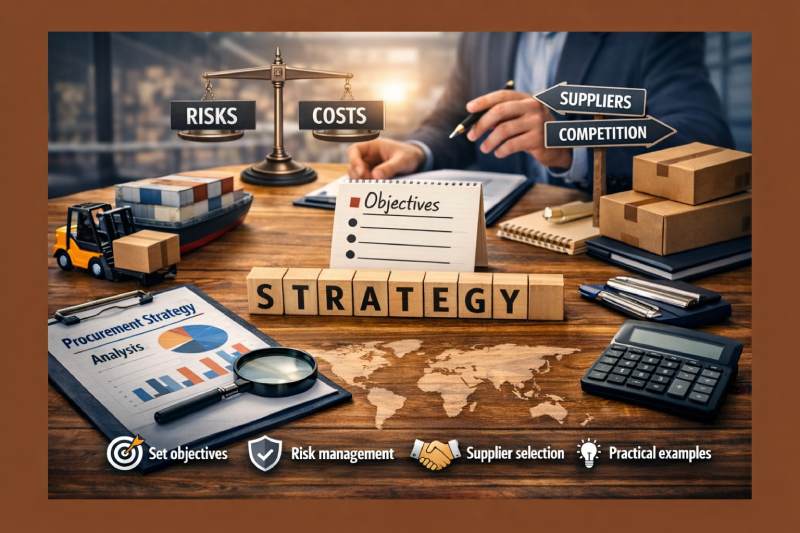
A procurement strategy defines the principles according to which sourcing decisions are made over the long term and how procurement contributes to cost efficiency, supply security and competitive advantage. It creates a binding framework for priorities, risks and decisions across all categories and suppliers.
A robust procurement strategy is not a theoretical construct for strategy papers, but a central leadership tool. In practice, many procurement organizations operate efficiently on an operational level, yet lack strategic direction. Decisions emerge from day-to-day business rather than from a clear long-term orientation.
This is where a structured approach becomes essential. Anyone who aims to develop a procurement strategy creates clarity: defining the role of procurement within the company, setting priorities and establishing decision principles. The focus goes far beyond cost – it includes value creation, risk management, supply security and long-term competitiveness.
What a Procurement Strategy Really Means
A procurement strategy describes the long-term framework for action in purchasing. It determines how sourcing decisions are made – not only what is sourced. At its core lies the alignment of procurement with overall corporate objectives.
In many organizations, however, the term “procurement strategy” is used too narrowly. Operational measures or short-term savings programs are often labeled as strategy. This perspective falls short. True strategic alignment provides a binding framework for decisions across categories, suppliers, markets and risks.
A sound procurement strategy answers key questions such as:
- Which categories are most critical to business success?
- Where do long-term partnerships make sense and where does competition create value?
- Which dependencies are acceptable and which should be actively reduced?
- How can standardization, flexibility and innovation be balanced effectively?
Only when these questions are clearly addressed does a procurement strategy provide real guidance and steer decisions sustainably.
Why Many Procurement Strategies Fail to Deliver Impact
In practice, many procurement strategies remain ineffective because they are formulated as theoretical target pictures without defining clear priorities and decision rules. Operational measures are presented as strategy, conflicts of objectives remain unaddressed, and responsibilities are left unclear. Without measurable targets, clear ownership and consistent integration into daily operations, even a well-written strategy quickly loses its steering effect.
Developing a Procurement Strategy in Line with Corporate Objectives
A procurement strategy only unfolds its impact when it is consistently derived from corporate goals. It does not exist in isolation, but in close interaction with growth plans, innovation targets, cost structures and the desired risk profile.
A company focused on growth requires scalable supplier structures. Another that prioritizes stability and supply security will emphasize redundancies and risk diversification. Accordingly, strategic procurement objectives differ significantly.
Typical strategic directions include:
- Ensuring supply continuity in volatile markets
- Achieving sustainable cost optimization across the entire lifecycle
- Building stable, high-performing supplier relationships
- Increasing transparency and controllability
- Integrating sustainability and compliance into sourcing
These objectives should not coexist on an equal footing. An effective procurement strategy sets clear priorities and makes trade-offs transparent.
Analysis as the Starting Point of Every Procurement Strategy
Before defining actions, transparency is essential. Without a solid analytical foundation, any procurement strategy remains an aspiration.
Spend and Category Analysis
A central step is analyzing the spend structure. Where is purchasing volume actually concentrated? Which categories carry high volume, complexity or risk? This differentiation forms the basis for developing targeted strategies instead of applying blanket optimization.
Supplier Structure and Dependencies
Equally important is understanding the supplier base. How is volume distributed? Where do single-source situations exist? Which suppliers are critical to value creation and which are easily replaceable? This analysis enables conscious decisions on sourcing models and dependencies.
Market and Environmental Assessment
Raw material markets, technological developments, regulatory requirements and geopolitical factors increasingly shape procurement. A strategy that ignores these conditions quickly loses relevance.
Defining Strategic Procurement Objectives Clearly and Measurably
From the analysis, concrete strategic objectives are derived. Precision is key. Generic statements such as “reduce costs” or “optimize the supplier base” provide little guidance.
Objectives should be formulated in a way that makes them manageable and verifiable. Instead of vaguely referring to risk reduction, a company might define a clear target: reducing the share of single-source suppliers in critical categories within a defined timeframe.
At the same time, conflicts of objectives must be addressed consciously. Cost reduction, supply security and sustainability do not always align. A professional procurement strategy makes these tensions transparent and takes clear decisions.
Deriving Procurement Strategies at Category Level
Procurement strategies create real impact at category level. This is where overarching direction is translated into concrete guidelines for operational action.
Depending on market and risk conditions, different approaches may be appropriate:
- Bundling and standardization to leverage economies of scale
- Dual or multi-sourcing to mitigate risk
- Local or global sourcing models
- Building long-term supplier partnerships
- Deliberate decoupling from highly volatile markets
The right option depends on market structure, volume, technical complexity and strategic relevance. One-size-fits-all solutions rarely deliver value.
From Strategy to Day-to-Day Execution
A procurement strategy is only as strong as its implementation. In practice, many strategies fail not in design, but in embedding them into daily operations.
Three factors are decisive:
First, clear accountability – every strategic decision needs a defined owner.
Second, translating strategy into processes, policies and decision logic.
Third, consistent communication so procurement, business units and management follow the same direction.
Practical Example: Procurement Strategy in an Industrial Environment
A mid-sized industrial company faced sharply rising material prices and strong supplier dependencies. Operational processes were professional, but a binding strategic framework was missing.
By developing a clear procurement strategy, categories were systematically prioritized, critical dependencies reduced and targeted strategic partnerships established. Within two years, the company significantly lowered its risk profile and stabilized its cost base.
This example shows how a well-defined procurement strategy creates room for maneuver even in challenging market conditions.
Shaping the Role of Procurement Deliberately
A modern procurement strategy also transforms the role of procurement itself. Purchasing evolves from a transactional function into a strategic partner. This requires new capabilities, a different mindset and close collaboration with other business areas.
Organizations with clear strategic alignment involve procurement earlier in decision-making. This increases influence and measurably improves outcome quality.
Common Pitfalls When Developing Procurement Strategies
Recurring challenges in practice include:
- Treating the procurement strategy as a one-off project
- Insufficient consideration of operational reality
- Objectives that remain too abstract
- Lack of implementation and performance tracking
A procurement strategy is not a static document. It must be reviewed and refined regularly without losing its fundamental direction.
Conclusion: Developing a Procurement Strategy Means Steering with Intent
Anyone who develops a procurement strategy takes responsibility – for costs, risks, supply security and the contribution of procurement to business success. A well-designed strategy creates clarity, improves decision-making and connects long-term objectives with operational reality.
Are you facing the challenge of sharpening your procurement strategy, setting clear priorities or making existing structures more effective?
In an initial, non-binding discussion, we analyze your starting point and identify which strategic levers in procurement can realistically deliver impact – whether the focus is on realignment, transformation or operational relief.
In an initial, non-binding consultation, we jointly assess your current situation and identify which strategic levers in procurement can deliver real impact — based on our procurement expertise and services.
FAQ on Procurement Strategy
What is a procurement strategy?
A procurement strategy defines the long-term framework for sourcing decisions and aligns procurement with corporate objectives.
When should a procurement strategy be developed?
When decisions become predominantly reactive or when market conditions, risks or corporate goals change significantly.
How do procurement strategies differ from measures?
Procurement strategies define the long-term direction; measures are concrete actions within this framework.
Who should be involved in developing a procurement strategy?
In addition to procurement, management, relevant business units and – where appropriate – key suppliers.
How often should a procurement strategy be reviewed?
Typically once a year or whenever major changes occur in the market or the company’s situation.