




Not every procurement category matters equally to a business. Some materials account for substantial expenditure but are available from numerous suppliers. Others are relatively inexpensive yet could bring production to a standstill if supplies are interrupted.
For procurement teams, that distinction matters. Treating every category in the same way can lead to unnecessary costs or put continuity of supply at risk.
The Kraljic Matrix helps businesses classify procurement categories according to their financial impact and supply risk. The results provide a basis for setting different priorities and taking appropriate procurement action.
What is the Kraljic Matrix?
The Kraljic Matrix is a strategic procurement tool that classifies materials and purchasing categories into four groups according to their impact on business performance and their supply risk.
The model was developed by Peter Kraljic and introduced in his 1983 Harvard Business Review article Purchasing Must Become Supply Management.
Kraljic argued that procurement should pay greater attention to supply markets and supplier dependencies rather than focusing primarily on prices and order processing.
His model, also known as the Kraljic Portfolio Matrix or Kraljic purchasing portfolio, remains widely used in strategic procurement. It helps organisations assess their categories and develop suitable sourcing strategies.
How does the Kraljic Matrix work?
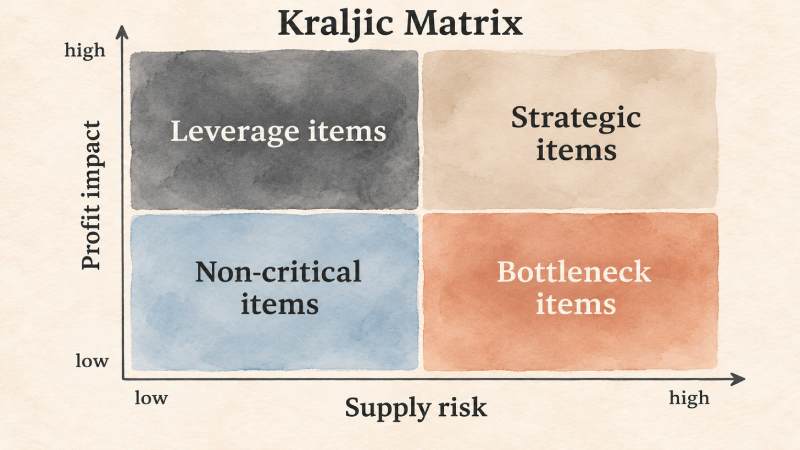
The Kraljic Matrix consists of four quadrants. Categories are positioned according to two dimensions:
1. Profit impact
Profit impact describes how strongly a purchasing category affects a company's financial performance. Factors may include annual spend, the share of a product's total cost attributable to the category, and its importance to competitiveness.
2. Supply risk
Supply risk indicates how secure the supply of a particular category is. Are enough qualified suppliers available? How long are lead times? And how difficult would it be to switch to another supplier in the event of a disruption?
Combining the two dimensions creates four categories:
The classification depends on the circumstances of each company. A material may be considered a non-critical item by one business and a strategic item by another.
The four quadrants of the Kraljic Matrix
Each quadrant calls for a different procurement focus. For some categories, improving prices and commercial terms is the priority. For others, maintaining a reliable supply is more important.
1. Strategic items: Secure long-term supplier relationships
Strategic items have a high impact on business performance and carry a high supply risk.
Examples include custom-made assemblies or technically complex components available from only a few manufacturers. Switching suppliers is often difficult and may seriously affect production.
Procurement teams should therefore plan ahead and work closely with their most important suppliers.
Suitable measures include:
- Long-term supply agreements and joint demand planning
- Regular discussions about capacity and potential delivery problems
- Joint development projects with suppliers
- Developing alternative sources of supply where technically and economically feasible
A low purchase price is not enough. If a critical supplier fails, the resulting costs can far exceed any savings achieved beforehand.
2. Leverage items: Make use of competition and purchasing power
Leverage items have a high financial impact but are relatively straightforward to source.
Typical examples include standardised raw materials or technical components available from several qualified suppliers.
Because the company can choose between suppliers, it often has a stronger negotiating position. Consolidating order volumes and running competitive tenders can help achieve better commercial terms.
However, procurement teams should not focus on price alone. Switching suppliers only makes sense if the alternative can meet the necessary quality and delivery requirements.
3. Bottleneck items: Prioritise security of supply
Bottleneck items have a relatively low financial impact but are difficult to source.
One example is a specialised replacement sensor available from just one manufacturer. The sensor itself may be inexpensive, but if it cannot be obtained, an entire machine could be out of action.
For bottleneck items, securing supply is therefore more important than negotiating the lowest possible price.
Depending on the product, safety stock or earlier ordering may be appropriate. Finding suitable substitutes and qualifying additional suppliers are other options.
These items illustrate why a low purchasing value does not necessarily mean a low supply risk.
4. Non-critical items: Simplify purchasing processes
Non-critical items have both a low profit impact and a low supply risk. They often include basic office supplies or standard consumables.
For these products, the administrative effort of purchasing can sometimes cost more than the goods themselves. Comparing quotations and obtaining multiple approvals for every small order creates unnecessary process costs.
Procurement teams should therefore aim to make purchasing as straightforward as possible. Framework agreements, fixed purchasing catalogues and automated ordering processes can reduce administrative work.
How to create a Kraljic Matrix for your procurement categories
Applying the Kraljic Matrix within a business begins with defining and assessing purchasing categories. A consistent approach makes it easier to compare the results.
Step 1: Define categories and collect procurement data
First, decide which materials and products should be assessed together.
Define the relevant procurement categories and gather purchasing data, including annual spend, available suppliers and previous delivery problems.
Categories need to be clearly defined. Combining products with very different supply conditions can distort the assessment.
Step 2: Assess profit impact
Next, examine the financial importance of each category.
Annual spend is one important measure. In a category where a business spends substantial amounts every year, even small price changes can have a significant financial effect.
Purchasing value is not the only factor, however. The effect on production costs or competitiveness may also be relevant.
Step 3: Evaluate supply risk
To assess risk, procurement teams examine the conditions in the relevant supply market.
Key questions include:
- How many qualified suppliers are available?
- How much effort would be involved in switching suppliers?
- Are special tools or technical approvals required?
- How reliable have deliveries been in the past?
- Are there dependencies on individual manufacturers or sourcing regions?
A company can introduce its own scoring system, for example rating individual criteria on a scale from 1 to 5 and weighting them if necessary.
There is no universally prescribed scoring formula for the Kraljic Matrix. What matters is that the criteria are applied consistently and reflect the actual supply situation.
Example of a simple supply risk assessment
A machinery manufacturer assesses its procurement categories using three supply risk criteria. A score of 1 represents low risk and 5 represents high risk.
| Assessment criterion | Standardised steel profiles | Custom control units |
|---|---|---|
| Availability of alternative suppliers | 1 | 5 |
| Effort involved in switching suppliers | 2 | 5 |
| Risk of prolonged supply interruptions | 2 | 4 |
| Average risk score | 1.7 | 4.7 |
This is a fictional, simplified assessment. All three criteria are weighted equally. The results are not standardised Kraljic risk scores.
The scores show why the two categories require different approaches.
For a meaningful classification, the company must also assess profit impact and establish its own thresholds for low and high scores. Numerical ratings do not replace market analysis or professional judgement.
Step 4: Position categories and decide on actions
Once both dimensions have been assessed, the purchasing categories can be plotted on the matrix.
Their positions provide guidance on appropriate procurement strategies. Competitive tenders may be a priority for leverage items, while ensuring continuity of supply may take precedence for bottleneck items.
Classification is not a one-off exercise. New suppliers may enter the market, while existing sources of supply may disappear. Procurement teams should therefore review their assessments regularly.
Practical example: Applying the Kraljic Matrix in machinery manufacturing
A medium-sized machinery manufacturer wants to review its procurement activities. It purchases custom control units, steel profiles and specialist replacement sensors, among other items.
The procurement team assesses four categories:
| Procurement category | Profit impact | Supply risk | Classification |
|---|---|---|---|
| Custom control units | High | High | Strategic items |
| Standardised steel profiles | High | Low | Leverage items |
| Specialist replacement sensors | Low | High | Bottleneck items |
| General office supplies | Low | Low | Non-critical items |
This example is fictional and intended to illustrate the approach. Actual classifications depend on each company's circumstances.
Custom control units have a significant financial impact and cannot readily be purchased from another manufacturer. Procurement should secure the existing supplier relationship over the long term while exploring whether additional sources could be developed.
The situation is different for steel profiles. With several suitable suppliers available, the company can compare quotations and renegotiate purchasing terms.
Specialist replacement sensors account for only a small proportion of purchasing costs but are available from a single manufacturer. Holding an appropriate level of safety stock could help avoid production downtime.
For general office supplies, simplifying the ordering process may be more useful, for example through a preferred supplier and a standardised purchasing procedure.
The matrix therefore helps identify different actions for each category. Which measures are ultimately implemented depends on cost and market conditions.
Kraljic Matrix vs ABC analysis: What is the difference?
Both ABC analysis and the Kraljic Matrix are used in procurement, but they approach prioritisation differently.
ABC analysis often classifies materials according to their annual consumption value. A items account for a large share of total consumption value, while C items represent a comparatively small share.
The Kraljic Matrix considers supply risk alongside financial importance.
A spare part may be classified as a C item because its annual consumption value is low. If it is only available from one supplier and its absence could disrupt production, it may nevertheless be classified as a bottleneck item in the Kraljic Matrix.
The two methods can therefore be used together. ABC analysis helps identify materials with a significant financial value, while the Kraljic Matrix adds an assessment of supply conditions.
The findings can feed into a broader procurement category strategy.
What are the limitations of the Kraljic Matrix?
The Kraljic Matrix makes it easier to assess a procurement portfolio, but it simplifies complex sourcing conditions.
One challenge is evaluating supply risk. Annual spend is usually relatively straightforward to determine from purchasing data, whereas supplier dependencies can be harder to assess objectively.
The boundaries between the four quadrants are not always clear either. Categories with intermediate scores do not necessarily point to one obvious strategy.
Supply markets can also change quickly. New suppliers, shortages and technological developments may affect the original classification.
The matrix is therefore a useful basis for strategic procurement decisions, but it cannot replace detailed market analysis or an assessment of the actual sourcing situation.
From the Kraljic Matrix to a procurement strategy
The Kraljic Matrix helps procurement teams identify categories with potential for cost savings and those where continuity of supply needs particular attention.
The real work begins after the assessment. Suitable measures must be defined and implemented for each category. These might include a new tender, qualifying an additional supplier or simplifying internal ordering procedures.
To remain useful over time, the findings should be reviewed regularly and incorporated into the company's wider procurement strategy.
Frequently asked questions about the Kraljic Matrix
What is the Kraljic Matrix in simple terms?
The Kraljic Matrix is an analytical tool for strategic procurement. It classifies materials and purchasing categories according to their financial importance and supply risk: strategic items, leverage items, bottleneck items and non-critical items. Different sourcing strategies can then be developed for each category.
What is a portfolio matrix?
A portfolio matrix is a tool for displaying different items or categories on a grid according to selected criteria. In procurement, the Kraljic Matrix is used to evaluate purchasing categories by profit impact and supply risk.
What is a four-quadrant matrix?
A four-quadrant matrix uses two axes to divide a set of items into four groups, usually by distinguishing between low and high values on each dimension. In the Kraljic Matrix, the four groups are strategic items, leverage items, bottleneck items and non-critical items.
Can you create a Kraljic Matrix in Excel?
Yes. Procurement categories can be listed and scored against defined criteria in Excel. The results can then be shown in an XY scatter chart, with profit impact and supply risk on the two axes. It is important to establish the assessment criteria and thresholds between quadrants beforehand.