

Indirect procurement is often underestimated. Yet in areas such as IT, facility management, consulting, marketing, maintenance and internal business requirements, costs can rise quickly when transparency is limited, approvals are unclear and purchasing decisions are made across many different departments.
While direct procurement is usually closely linked to production, material availability and delivery capability, indirect requirements often arise in a decentralised and fragmented way. Each individual purchase may look manageable. In total, however, these purchases can create significant spend, unnecessary process costs and complex supplier structures.
Companies that want to optimise indirect procurement should therefore not focus only on purchase prices. The real impact lies in the interaction between transparency, category management, supplier management, simple approval processes and digital procurement workflows.
SJL Management & Consulting supports companies in professionalising procurement processes, structuring procurement organisations and making cost potential visible. Find out more about our approach under Our Services.
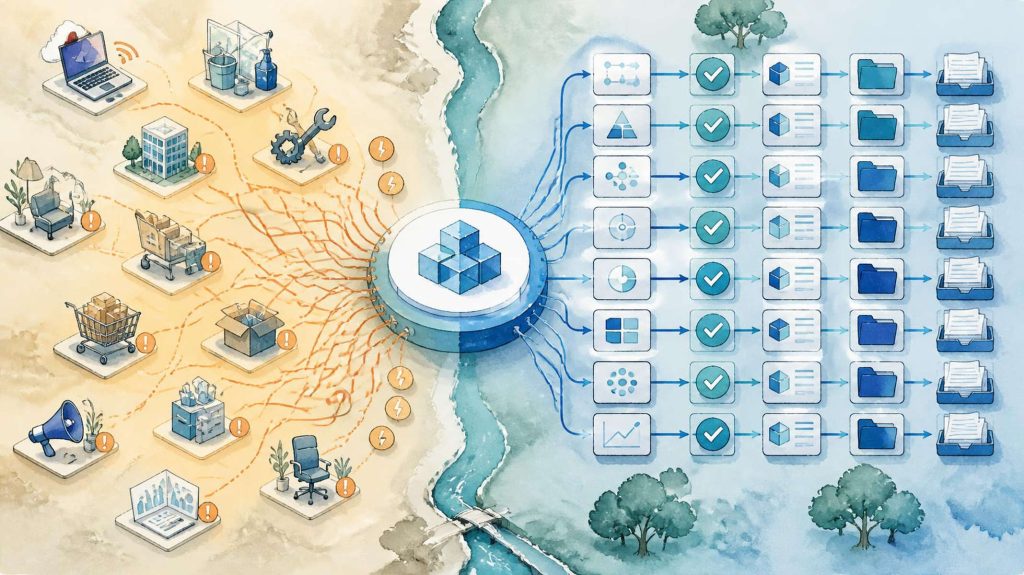
What is indirect procurement?
Indirect procurement covers all goods and services a company needs for its ongoing business operations, but which do not directly become part of the final product or core service.
In a manufacturing company, raw materials, components or production-critical parts usually belong to direct procurement. IT systems, cleaning services, external consulting, office supplies or building maintenance typically fall under indirect procurement.
A simple definition is:
Indirect procurement refers to the sourcing of goods and services that support business operations but do not directly become part of the product sold or the core service delivered.
In practice, the term indirect purchasing is often used in the same context. SAP also distinguishes direct procurement from indirect procurement by explaining that direct procurement contributes directly to the goods and services a company sells, while indirect procurement supports operational needs. See SAP’s English-language overview on direct vs indirect procurement.
Direct and indirect procurement: what is the difference?
Direct and indirect procurement differ mainly in the purpose of the goods and services being purchased.
Direct procurement sources materials, goods or services that flow directly into a company’s product, service or operational delivery. Indirect procurement, by contrast, ensures that the internal business can function.
| Criterion | Direct procurement | Indirect procurement |
|---|---|---|
| Purpose | Procurement for product, production or core service delivery | Procurement for internal use and business operations |
| Examples | Raw materials, components, traded goods, production-relevant parts | IT, facility management, consulting, marketing, office supplies, maintenance |
| Planning | Often closely linked to production or sales planning | Often smaller, more irregular and more decentralised |
| Main risks | Supply capability, production downtime, quality | Cost control, transparency, compliance, process effort |
| Supplier structure | Often strategically managed | Often broad and historically grown |
| Steering | Usually clearly anchored in procurement | Often spread across business functions, procurement and finance |
Direct procurement therefore often secures the company’s ability to deliver its product or service. Indirect procurement has a strong impact on how efficiently, transparently and consistently the company works internally.
The distinction is not identical in every business. What counts as direct or indirect depends on the company’s operating model.
For a broader view of how operational and strategic procurement responsibilities work together, see Operational vs Strategic Procurement.
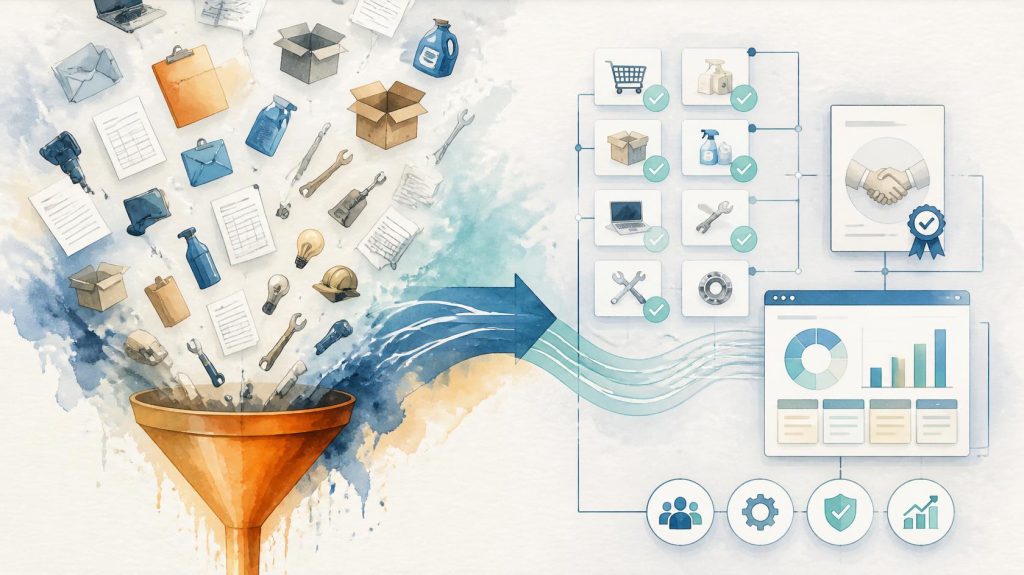
Typical categories and examples in indirect procurement
Indirect procurement covers a wide range of categories. This variety is one reason why the area is often harder to manage organisationally than direct procurement.
Typical examples include:
- IT hardware, software and cloud services
- facility management, cleaning and building technology
- maintenance, repair and operations
- marketing and communications services
- external consulting and project support
- office supplies and business equipment
- training and development
- travel, mobility and events
- insurance and legal services
- temporary labour and external specialists
- health and safety equipment
- internal consumables
Examples of indirect materials
In addition to services, indirect procurement also includes many materials. Indirect materials are needed internally, but they do not directly become part of the final product.
Examples include paper and printer supplies, IT accessories such as cables or monitors, cleaning and hygiene materials, personal protective equipment, maintenance tools and spare parts for internal repair work.
The individual requirement is often small. This is exactly where the challenge begins: many small purchases across different departments and suppliers can create significant administrative effort.
Companies should therefore assess which indirect materials can be standardised, bundled, catalogued or purchased through framework agreements.
Why indirect procurement often becomes a cost trap
Indirect procurement rarely becomes expensive because of one major wrong decision. The cost problem usually arises from the sum of many small transactions that are not sufficiently managed.
A department commissions a service provider at short notice. A software licence renews automatically. A new supplier is created although a framework agreement already exists. An invoice arrives without a purchase order in the system.
Each individual case may appear harmless. If these cases repeat regularly, they become structural cost traps.
Lack of transparency over spend and suppliers
In direct procurement, many companies know exactly which materials are purchased, at which price and from which supplier. In indirect procurement, this level of transparency is often weaker.
Requirements arise in many departments, budgets sit in different places and supplier structures have often grown over many years. At the same time, companies may lack consistent categories, clean master data or a central overview of contracts and renewal dates.
As a result, procurement often only sees afterwards which spend has already occurred.
Without transparency, it is difficult to identify relevant cost blocks, duplicate suppliers, overlapping services or potential bundling opportunities.
Clear roles and responsibilities are therefore an essential part of an effective procurement organisation.
Maverick buying: when departments purchase around procurement
Another common cost trap is maverick buying. This means purchasing outside defined procurement processes, approved suppliers or existing framework agreements.
Examples include departments ordering directly from a provider, invoices arriving without a prior purchase order or new suppliers being used although suitable contract suppliers already exist.
Maverick buying is not always a discipline problem. It often reveals weaknesses in the process itself. If approvals are slow, responsibilities are unclear or framework agreements are difficult for employees to find, alternative purchasing routes quickly emerge.
The better solution is therefore not simply more control. The compliant procurement route must be practical enough that departments have no reason to bypass it.
More on this topic: Maverick Buying: How to Stop Uncontrolled Procurement.
High process costs for low-value purchases
In indirect procurement, many orders have comparatively low value. Nevertheless, each order may trigger several steps: clarify demand, select supplier, check offer, create order, confirm service, match invoice and approve payment.
If this process is manual, inconsistent or full of queries between the department, procurement and finance, the process cost can become disproportionately high compared with the order value.
A typical example is a small purchase that requires several employees to deal with approvals, cost centres, purchase order numbers and invoice matching. In such cases, the purchase price may not be the main issue. The process behind it is.
Cost optimisation in indirect procurement is therefore not only about negotiating better conditions. It is also about reducing unnecessary administrative effort.
More approaches can be found in Cost Optimisation in Procurement.
Unclear responsibilities and approvals
Indirect procurement often sits at the interface between procurement, business functions, finance, IT, facility management and senior management.
If it is not clear who decides what, delays and grey areas arise.
Who may select a supplier? From which value must procurement be involved? Who checks the budget? Who is responsible for contract terms and notice periods? Which purchases may departments trigger themselves?
Without clear answers, the process either becomes slow and bureaucratic or it is bypassed. Both create additional cost.
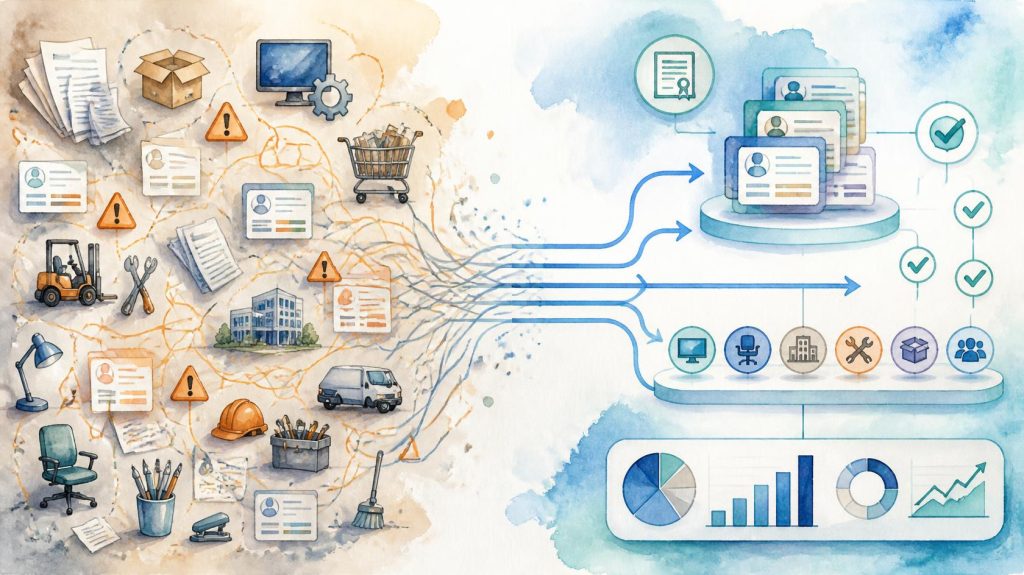
What are indirect procurement costs?
Indirect procurement costs include all costs that arise from buying goods and services for internal business operations.
This includes the actual spend on software, facility management, consulting, marketing, maintenance, office supplies and other indirect requirements. But it also includes costs created by the procurement process itself: supplier selection, order processing, approvals, invoice checking, contract administration and supplier management.
Further costs may result from unused framework agreements, an overly large supplier base, unnecessary individual purchases or automatic contract renewals that are not reviewed regularly.
In indirect procurement, these costs often remain hidden for a long time because they are distributed across many cost centres, departments and suppliers.
A reliable data basis is therefore essential to distinguish real cost drivers from isolated issues.
What are the tasks of indirect procurement?
Professional indirect procurement goes far beyond operational order processing. Its task is to structure requirements, suppliers, processes and costs so that indirect purchasing becomes manageable.
Bundling demand and structuring categories
The starting point is transparency over which indirect requirements occur regularly and which of them can be sensibly bundled.
IT, facility management, marketing, consulting and maintenance should not be viewed only from the perspective of individual cost centres. A category perspective shows which similar services are purchased across the company and where volumes can be consolidated.
A robust category management approach helps assess markets, suppliers and requirements systematically and establish clear responsibilities.
Selecting, evaluating and consolidating suppliers
A historically grown supplier base creates considerable administrative effort. Every additional supplier must be created, checked, managed and paid.
In indirect procurement, this structure often grows gradually. Departments use their own contacts, urgent requirements lead to new providers and similar services are bought from several suppliers in parallel.
Procurement should therefore regularly assess which suppliers are actually used, where overlaps exist and which services can be bundled.
Supplier consolidation does not mean reducing the number of suppliers as aggressively as possible. The goal is a manageable and capable supplier structure that balances commercial performance, quality, competition and supply reliability.
For more on risk-based supplier steering, see Supplier Management: Identifying Risks Early.
Establishing framework agreements and simple purchasing routes
Framework agreements only create value when they are actually used in day-to-day work.
Departments need to see quickly which suppliers are approved, which services can be sourced through existing contracts and which conditions have been agreed.
At the same time, approval processes must fit the value and risk of the purchase. A low-value office requirement should not go through the same approval path as a multi-year consulting contract.
Clear value thresholds, defined responsibilities and understandable exception processes create control without slowing procurement unnecessarily.
Monitoring KPIs and budgets
Indirect procurement needs reliable data. Without KPIs, it remains unclear whether implemented measures are working.
Relevant indicators include indirect spend per category, number of active suppliers, share of purchases through framework agreements, invoices without purchase order reference and approval lead times.
More KPIs do not automatically create better steering. The decisive question is whether the data leads to decisions.
How KPIs can be used as a real steering instrument is explained in Procurement Controlling: Steering Instead of KPI Collection.
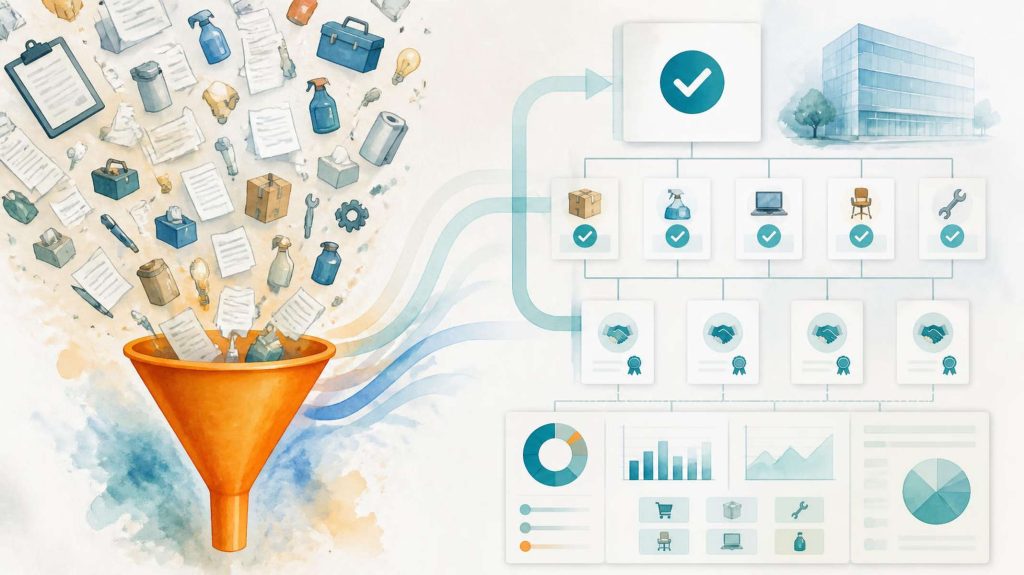
Optimising indirect procurement: 7 practical levers
Optimising indirect procurement does not mean cutting every expense across the board. Sustainable impact is created when data, processes, responsibilities, suppliers and systems work together.
1. Conduct a spend analysis
The first step is a clean analysis of spend. Orders, invoices, suppliers, categories, cost centres and existing contracts should be assessed together.
The goal is not only to determine a total amount. The key is to make patterns visible:
Where are high indirect costs being created? Which categories are particularly fragmented? Where are there many small orders? Which suppliers are used in parallel for similar services? Which spend runs outside defined processes?
A spend analysis creates the basis for all further decisions. CIPS also highlights spend analysis as a way to improve visibility, identify savings and align procurement spend with organisational strategy: CIPS on spend analysis.
2. Define categories and responsibilities
Indirect spend needs clear ownership.
For each relevant category, it should be defined who owns the business requirement, when procurement must be involved and who decides on suppliers or contracts.
This is especially important for services. Consulting, marketing, IT or facility management cannot be steered effectively if several departments buy and negotiate similar services independently.
Clear roles reduce duplication and improve the negotiating position with suppliers.
3. Consolidate the supplier base
Many suppliers do not automatically mean more flexibility. In fragmented categories, they often lead to greater administrative effort, weaker transparency and fewer opportunities to bundle volume.
Companies should therefore assess where services can be bundled through fewer, but deliberately selected, suppliers.
This is especially relevant in categories with many similar suppliers, recurring services and high administrative workload.
The key question is not:
How can we reduce as many suppliers as possible?
The better question is:
Which suppliers do we really need to secure quality, competition, speed and commercial value?
4. Simplify approval processes
Approvals are important, but they must reflect the value and risk of the purchase.
Too many approval steps slow processes down and increase the likelihood that employees look for alternative routes.
A good approval process defines clear value thresholds, budget responsibility, business review, procurement involvement and exceptions.
The status of an order should also be transparent for everyone involved. Transparency reduces queries and accelerates decisions.
5. Reduce maverick buying
Maverick buying can only be reduced sustainably if the company understands why purchases are being made outside the intended process.
Common causes include limited awareness of procurement policies, unclear contact persons, slow approvals, complex systems, missing catalogues or framework agreements that business functions cannot easily find.
It is therefore not enough to control violations more strictly.
The more effective principle is:
The correct procurement route must be easier than bypassing it.
6. Use digital procurement solutions selectively
Digital procurement can make indirect purchasing significantly more transparent and efficient.
E-procurement systems, digital catalogues, automated approval workflows and central reporting help manage requirements, orders, suppliers and invoices more effectively.
Before introducing a new system, however, companies should first clarify their processes.
Which purchasing cases must be covered? Which categories are suitable for catalogues? Which approvals can be automated? Which data is needed for reporting and steering?
A poor process does not automatically become a good process because it is digital.
Digital tools create the most value when processes, data and responsibilities are already aligned.
7. Review KPIs regularly
After implementation, the real steering begins.
A small number of relevant KPIs is often enough. What matters is that they are not only collected and reported, but used to trigger decisions.
For example, if the number of invoices without purchase orders increases, the KPI should not merely be documented. The cause must be understood: is the issue in the department, with the supplier, in the approval process or in the system?
Good KPIs therefore do not only show that something deviates. They help explain why it deviates and what action is required.
Important KPIs in indirect procurement
KPIs make indirect procurement measurable and manageable. A small number of consistently used KPIs often creates more value than extensive reporting without clear consequences.
| KPI | Meaning | Benefit |
|---|---|---|
| Indirect procurement volume | Total spend on indirect goods and services | Shows relevance and key categories |
| Maverick buying rate | Share of procurement outside defined processes | Makes process deviations visible |
| Share through framework agreements | Share of procurement through defined contract suppliers | Shows whether agreed contracts are actually used |
| Active suppliers per category | Number of suppliers used within a category | Reveals consolidation potential |
| Process cost per order | Internal effort per procurement transaction | Shows inefficient purchasing routes |
| Invoices without purchase order | Invoices without prior purchase order reference | Makes process and compliance gaps visible |
| Approval lead time | Time between requirement and approval | Shows bottlenecks in the procurement process |
| Share of digital orders | Share of system-supported procurement transactions | Shows process maturity and system adoption |
Which KPIs are relevant depends on the company, its procurement structure and its objectives. The decisive factor is not the number of KPIs, but whether concrete measures can be derived from them.
Checklist: is your indirect procurement well managed?
These questions support an initial assessment:
- Is there a current overview of indirect spend by category?
- Are the most important suppliers and contracts known?
- Are responsibilities clear for IT, facility, marketing, consulting and other indirect categories?
- Are framework agreements easy for departments to find?
- Do employees know when procurement must be involved?
- Are approval thresholds clear and understandable?
- Are invoices without purchase orders reviewed regularly?
- Is maverick buying measurable?
- Are standard requirements easy to order, ideally through digital routes?
- Is the supplier base reviewed regularly?
- Are there a few clearly defined KPIs?
- Do procurement, business functions and finance work according to shared rules?
If several of these questions cannot be answered clearly, the issue is usually not a single procurement problem. More often, the overall steering of indirect procurement is missing.
When external support makes sense
External support can be particularly useful when several challenges occur at the same time: rising costs, an unclear supplier base, different processes between departments or limited transparency over spend and contracts.
Larger optimisation or transformation projects are also not always feasible on top of day-to-day procurement work.
In these situations, external support should not end with an analysis or workshop. The decisive factor is the connection between analysis, structure and practical implementation.
SJL Management & Consulting supports companies in making procurement organisations more effective, structuring purchasing processes and making cost potential visible. The focus is on practical solutions, clear responsibilities and measurable improvements.
If short-term procurement expertise, process steering or operational implementation capacity is needed, Interim Management in Procurement can also be a suitable solution.
Project examples and implementation fields can be found under Projects.
Conclusion: indirect procurement needs transparency and clear steering
Indirect procurement is far more than office supplies or internal services. It affects costs, processes, supplier structures and compliance across the whole company.
The biggest cost trap rarely comes from one wrong order. It comes from many small inefficiencies: limited transparency, decentralised decisions, unused framework agreements, an overly broad supplier base or procurement processes that do not work in everyday business.
Companies that want to optimise indirect procurement should therefore first create transparency over spend and suppliers. Based on this, categories can be structured, responsibilities defined, suppliers sensibly consolidated and purchasing processes simplified.
The seven central levers are: a robust spend analysis, clear responsibilities, a manageable supplier base, simple approvals, reduced maverick buying, targeted digital procurement solutions and consistent steering through relevant KPIs.
This turns indirect procurement from a difficult-to-control cost block into an effective lever for efficiency, transparency and sustainable cost control.
Make indirect spend transparent and steer procurement effectively
Would you like to analyse your indirect procurement, make cost traps visible or structure procurement processes more clearly between procurement, business functions and finance?
SJL Management & Consulting supports you in creating transparency, clarifying responsibilities and implementing practical measures for more effective procurement steering.
FAQ on indirect procurement
What is an example of indirect procurement?
A typical example is the purchase of software for internal employees. The software does not become part of the product sold, but it is necessary for internal processes to function. Other examples include facility management, consulting, office equipment, maintenance and marketing services.
What is the difference between direct and indirect procurement?
Direct procurement sources materials and services that are directly needed for a company’s product or core service. Indirect procurement covers internal requirements such as IT, facility management, consulting, office supplies or maintenance.
What are indirect procurement costs?
Indirect procurement costs include spend on indirect goods and services as well as process costs for orders, approvals, supplier management, contract administration and invoice checking.
What are the tasks of indirect procurement?
Key tasks include spend analysis, category management, supplier selection and steering, framework agreements, approval processes, cost control and reducing maverick buying.
How can indirect procurement be optimised?
Indirect procurement can be optimised through transparent spend data, clear responsibilities, structured categories, sensible supplier consolidation, simpler approvals, digital procurement processes and consistent KPI steering.