





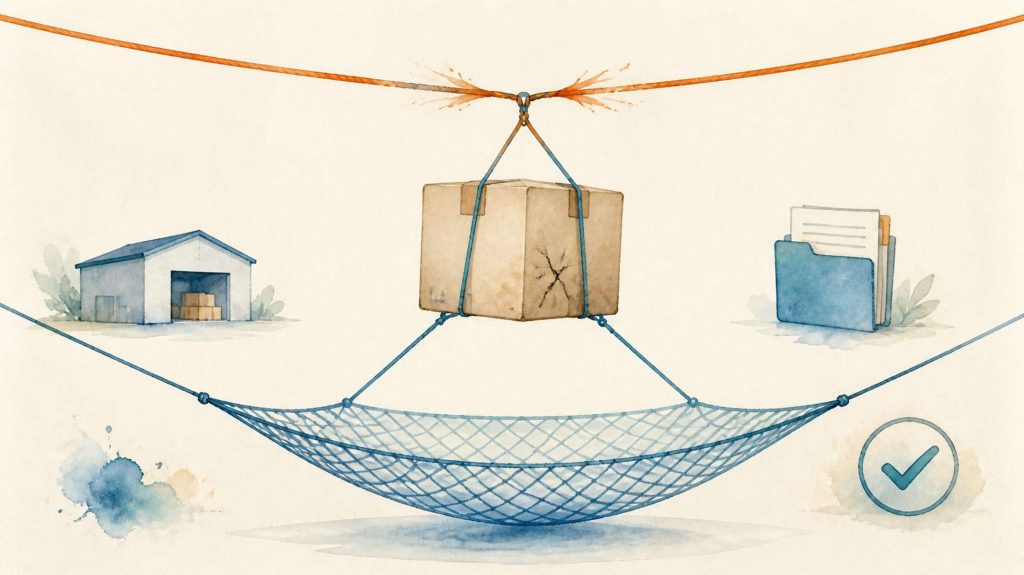
Dual sourcing helps companies reduce supplier dependency and manage procurement risks more effectively. The principle is simple: a critical requirement is deliberately covered by two qualified suppliers instead of one. In practice, however, the strategy only works when the second source is not treated as a passive emergency option, but actively embedded in procurement strategy, category management and supplier steering.
For critical materials, components or services, full dependency on a single supplier can quickly become a business risk. Delivery delays, quality issues, capacity constraints or changing market conditions can directly affect production, customer service and supply capability.
Dual sourcing creates an alternative. But it does not automatically create resilience. Simply adding a second supplier to the database may increase complexity without improving security of supply.
A robust dual sourcing strategy answers three core questions: where are two sources economically justified, how should volumes be allocated, and how can both suppliers remain capable over time?
SJL Management & Consulting supports companies in strengthening procurement structures, supplier management and strategic sourcing. More about our approach: Our Services.
What is dual sourcing?
Dual sourcing is a procurement strategy in which a company sources or secures a product, material, service or category through two suppliers.
Both sources should be qualified, capable of supplying and integrated into the procurement strategy. The second supplier is not merely a name in a supplier list; it must be able to deliver when required.
Short definition:
Dual sourcing means securing a critical requirement through two qualified sources in order to reduce supplier dependency and increase flexibility in procurement.
An external English-language definition is provided by TechTarget’s explanation of dual sourcing.
What does double sourcing mean?
Double sourcing is usually used as a synonym for dual sourcing. Both terms describe the same basic approach: a company does not rely on only one source for a specific requirement, but works with two suppliers.
This should be distinguished from multi sourcing or multiple sourcing. Multi sourcing uses more than two suppliers for one requirement.
More suppliers do not automatically mean more security. Each additional source increases the need for coordination, qualification, contract management and performance monitoring.
Why dual sourcing is more than adding a second supplier
A second supplier alone does not make a supply chain resilient.
The key question is whether that supplier can actually step in when needed. Technical requirements must be clarified, quality must be validated, capacity must be understood and commercial terms must be agreed. Lead times, logistics, prices and escalation paths also need to be defined.
A second-source supplier that has not delivered relevant volumes for years may not be able to provide capacity at short notice during a disruption.
That is why the second source must be actively developed and regularly assessed. Professional supplier management is therefore a central part of any effective dual sourcing strategy.

Single sourcing, dual sourcing and multi sourcing compared
The right sourcing strategy depends on the category, market structure, risk profile, purchasing volume and the organisation’s ability to manage complexity.
| Strategy | Meaning | Benefit | Risk |
|---|---|---|---|
| Single sourcing | One requirement is covered by one supplier | Clear supplier relationship, simple steering, possible bundling benefits | High dependency on one supplier |
| Dual sourcing | One requirement is covered by two suppliers | Higher security of supply, second source, more flexibility | Additional coordination and steering effort |
| Multi sourcing | One requirement is covered by several suppliers | Broad supplier base and high flexibility | More complexity and less volume bundling |
A single source supplier covers a specific requirement alone. That is not automatically wrong.
Single sourcing can be strategically useful when specialist know-how, a close development partnership, high quality requirements or economies of scale are more important than supplier diversification.
It becomes critical when a deliberate sourcing decision turns into an unmanaged dependency. Warning signs include a lack of qualified alternatives, highly supplier-specific technical requirements or a situation in which delivery problems would directly affect production or customer service.
The decision between single sourcing, dual sourcing and multi sourcing should therefore always be part of a broader procurement strategy.
What are the benefits of dual sourcing?
The main benefits of dual sourcing are security of supply, flexibility and lower dependency on individual suppliers. The strategy can also improve market transparency and negotiation options when both suppliers are actively managed.
Greater security of supply for critical requirements
The most obvious benefit is protection against supplier failure.
If one supplier cannot deliver, a qualified second source already exists. This can be decisive in the event of capacity shortages, quality problems, regional disruption, logistics constraints or financial difficulties at a supplier.
However, the alternative source must be built before the disruption occurs. Supplier qualification, technical alignment and operational integration take time. A company that starts looking for an alternative supplier during a crisis does not yet have dual sourcing; it has a supplier search under pressure.
McKinsey also discusses dual sourcing in the context of supply chain risk and resilience, noting that companies have been pursuing dual-sourcing strategies to improve structural resilience. See the McKinsey Global Supply Chain Leader Survey 2024.
Stronger negotiating position
A realistic second source changes the negotiating position of procurement.
When a company is completely dependent on one supplier, price increases, capacity allocation and contract conditions are harder to influence. Dual sourcing creates comparability.
Prices, quality, delivery reliability and service performance can be assessed across two capable suppliers. This provides more market transparency and can support negotiations.
At the same time, procurement should not treat dual sourcing as a permanent supplier competition exercise. Sustainable sourcing requires reliable relationships. The competitive effect only works when both suppliers are genuine alternatives.
More flexibility when demand or capacity changes
Dual sourcing can also help companies manage fluctuating demand more effectively.
If demand rises at short notice, additional volume can be allocated to the second source. If one supplier reaches its capacity limit, another qualified supplier is already available.
This is especially relevant for long lead times, volatile demand, technically critical components or limited production capacity.
Dual sourcing is therefore not only insurance against complete supplier failure. It can also increase operational flexibility in day-to-day procurement.

Benefits and risks of dual sourcing at a glance
The benefits of dual sourcing do not come without additional requirements. Two suppliers need to be qualified, contracted, monitored and actively managed.
| Area | Benefits of dual sourcing | Possible risks |
|---|---|---|
| Security of supply | Disruptions can be absorbed more effectively | The second source may not be operationally ready without active management |
| Negotiation | More alternatives and better market transparency | Excessive competition can damage supplier relationships |
| Flexibility | Volumes can be split between two suppliers | Planning and coordination become more demanding |
| Quality | Supplier performance becomes comparable | Quality differences must be actively managed |
| Cost | Price and contract terms can be compared | Lower bundling may increase unit costs |
| Organisation | Dependencies become more transparent | More suppliers create additional steering effort |
The real disadvantage is not dual sourcing itself, but an uncontrolled expansion of the supplier base.
Two suppliers mean additional qualification, contract management, quality checks, supplier evaluation and operational interfaces. That is why dual sourcing should not be applied to every category on the assumption that “two is always safer than one”.
The second source must create economic or strategic value that justifies the additional management effort.
When does dual sourcing make sense?
Dual sourcing is particularly relevant when a requirement is business-critical and the failure of the current supplier would have significant consequences.
Not every category meets this condition.
For easily available standard items with low procurement risk, a well-managed single sourcing model can be more efficient. For strategic components with long qualification times, the situation is very different.
| Situation | Is dual sourcing useful? | Reason |
|---|---|---|
| Critical category with high disruption risk | Yes | A second source increases security of supply |
| Monopoly-like market with few alternatives | Limited | Building an alternative may be difficult or time-consuming |
| Non-critical C-parts with stable availability | Often no | Additional complexity may outweigh the benefit |
| High technical specialisation | Yes, but early | Qualifying a second supplier takes time |
| Strongly fluctuating demand | Yes | Additional volume flexibility can help |
| Very low volumes | Rather no | Keeping two suppliers active may be commercially difficult |
| Strategic key component | Often yes | Protecting against failure is highly important |
The key question is therefore not:
Where could we add a second supplier?
The better question is:
Where is our dependency so critical that a second source justifies the additional effort?
A structured category management approach helps make this decision based on risk, market structure and commercial relevance rather than assumption.
Identify single-source risks early
Many critical dependencies do not arise from a deliberate strategic decision. They grow over time.
A supplier develops a product together with the company. Specifications become increasingly aligned with that supplier’s technology. Specialist departments become used to the relationship. Alternative suppliers are no longer checked regularly.
At some point, there is only one realistic source.
Procurement should therefore regularly analyse which suppliers are indispensable for critical categories, how quickly they could be replaced and which technical, regional or economic dependencies exist.
Gartner also highlights that organisations can struggle to understand the full risk of single and sole sourcing and should assess such dependencies systematically. See Gartner’s resource on controlling uncertainty around single- and sole-sourcing risks.
Relevant KPIs such as single-source share, supplier concentration, delivery reliability and risk ratings can be made visible through procurement controlling.
Implementing dual sourcing: 5 steps
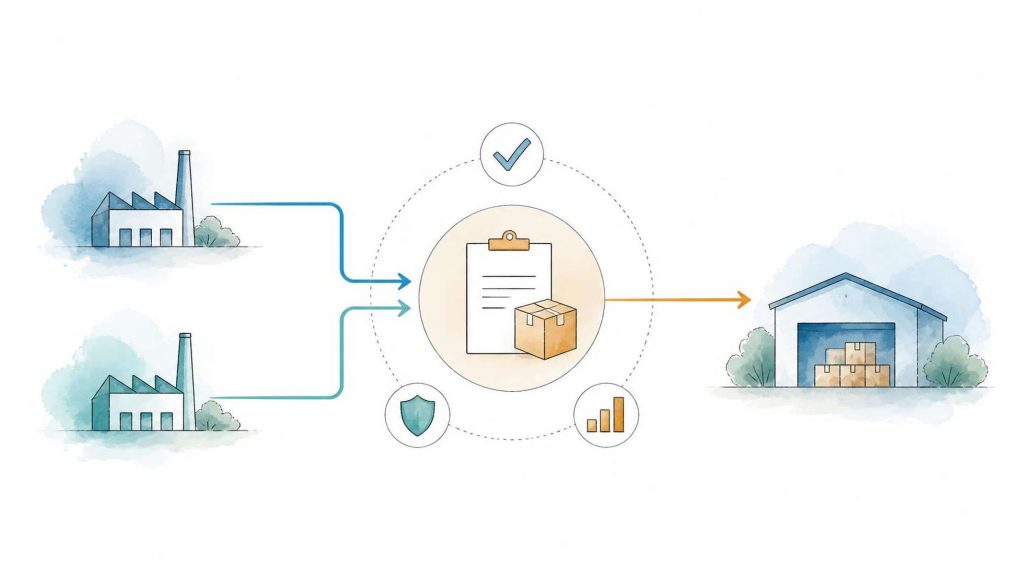
An effective dual sourcing strategy needs clear guardrails. Procurement must decide which requirements should be secured, how suitable second-source suppliers should be selected and how both sources should be managed over time.
1. Identify critical requirements
The first step is not to search for a second supplier. It is to assess risk.
Companies should identify the categories where supplier failure would genuinely be critical.
Relevant criteria include:
- impact on production, service or customer delivery
- technical specialisation
- number of available suppliers
- lead times and replenishment times
- quality requirements
- purchasing volume
- price and capacity risks
- regional dependencies
- historic supplier performance
This assessment shows where dual sourcing creates genuine value. It also prevents the strategy from being rolled out too broadly across the supplier base.
2. Select and qualify the second source deliberately
A second-source supplier should not be selected simply because it is cheaper or immediately available.
Long-term suitability matters more.
Technical capability, quality, capacity and delivery reliability are just as important as cost structure, financial stability, location, logistics risk and willingness to collaborate.
For technically complex products, procurement should not make the selection alone. Quality, engineering, specialist departments and logistics may need to be involved early. Otherwise, the company may select a supplier without creating a truly operational second source.
3. Define roles, responsibilities and KPIs
Dual sourcing increases the need for steering. It must be clear who makes which decisions.
Who owns the category? Who develops the second supplier? Who assesses quality and delivery performance? Who decides volume allocation? Who manages escalation?
These roles should not be discussed for the first time when volumes need to be shifted between suppliers.
A clear procurement organisation prevents strategic decisions from getting stuck between procurement, quality, engineering and specialist departments.
Performance measurement should also be defined from the start. Both suppliers need comparable KPIs wherever possible.
4. Allocate volumes consciously between suppliers
Dual sourcing only works when the second source remains active.
If a second supplier receives no relevant volume for a long period, it is unrealistic to expect immediate capacity during a crisis.
A 50/50 split is not always necessary. Common models include:
- 80/20 model: the main supplier receives most of the volume, while the second supplier remains active.
- 70/30 model: volume is split more evenly where risk is higher.
- Primary/secondary model: one supplier leads, while the second source remains a qualified backup.
- Regional split: suppliers serve different plants, regions or markets.
- Product-based split: variants or specifications are allocated between suppliers.
The right model depends on risk, volume, cost, minimum order quantities and available capacity.
The important point is that the allocation is deliberate rather than accidental.
5. Measure supplier performance regularly
Dual sourcing is not a one-off procurement project.
Both suppliers should be assessed continuously. Only then can procurement see whether the second source is a reliable alternative.
Useful KPIs include:
- on-time delivery
- quality rate
- complaint rate
- price development
- capacity availability
- response speed
- supplier risk
- share of purchasing volume
- development progress of the second source
A supplier whose performance remains significantly weaker over time does not create additional security. It creates a new problem.
Dual sourcing and cost optimisation should be considered together
Dual sourcing is often treated primarily as a risk strategy. However, commercial impact must not be ignored.
A second source can create more market transparency and support price or contract negotiations. At the same time, purchasing volume is split across two suppliers, which may reduce bundling benefits.
There are also costs for qualification, supplier management, quality assurance and additional operational processes.
That is why the unit price alone is not enough.
The relevant question is:
What does the second source cost, and which risk does it reduce?
A slightly higher procurement price may be economically sensible if it helps prevent an expensive production stoppage. Conversely, a second source is difficult to justify if the disruption risk is low and the additional steering effort is high.
Professional cost optimisation in procurement is therefore not simply about buying from the cheapest supplier. It assesses price, process costs, risk and organisational resilience together.

Checklist: is dual sourcing useful for your category?
The following questions help with an initial assessment:
- Is the requirement critical for production, service or customer delivery?
- Is there currently only one qualified supplier?
- Would supplier failure be difficult to compensate at short notice?
- Are alternative suppliers available in the market?
- Are there technical or regulatory barriers to switching suppliers?
- Is the purchasing volume large enough to keep two suppliers active?
- Can volumes be split sensibly?
- Are requirements and specifications sufficiently documented?
- Are responsibilities for both suppliers clearly defined?
- Are supplier performance and risks measured regularly?
- Is the additional steering effort commercially justified?
- Does dual sourcing fit the wider procurement and category strategy?
The more these questions point to critical dependency and a realistic second source, the more worthwhile a detailed assessment becomes.
When external support makes sense
Building a dual sourcing strategy becomes particularly challenging when supplier dependencies are already critical, transparency over the supplier base is limited or operational pressure leaves little room for strategic work.
External support can help assess critical categories, make single-source risks visible and develop suitable second-source suppliers.
The important point is not to stop at the analysis.
A second source must be selected, qualified, contracted and transferred into operational steering.
SJL Management & Consulting supports companies in developing procurement organisations and supplier structures as well as implementing strategic sourcing measures in practice.
If short-term experience and implementation capacity are required in procurement, interim management in procurement can also be a suitable solution.
Examples of project fields and implementation focus areas can be found under Projects.
Conclusion: dual sourcing needs clear steering, not more suppliers
Dual sourcing can reduce supplier dependency, improve security of supply and strengthen procurement’s ability to act. But the benefit does not arise simply because a second supplier exists.
Not every category needs dual sourcing. Not every second supplier creates real security. And not every additional supplier relationship is commercially sensible.
The decisive factor is deliberate selection.
Companies should first identify which requirements are genuinely critical. They then need to qualify a second source, keep it active and manage both suppliers through clear volumes, responsibilities and KPIs.
The five core steps are:
- identify critical requirements,
- qualify a suitable second source,
- define responsibilities and KPIs,
- allocate volumes deliberately, and
- measure the performance of both suppliers regularly.
When dual sourcing is connected to procurement strategy, category management, supplier management and procurement controlling, it does not create an unnecessarily large supplier base. It creates a more resilient procurement structure.
Reduce supplier dependency and strengthen your sourcing strategy
Would you like to make single-source risks visible, assess critical categories or build a practical dual sourcing strategy?
SJL Management & Consulting supports you in analysing supplier dependencies, developing second-source suppliers and strengthening procurement structures sustainably.
FAQ on dual sourcing
What is dual sourcing?
Dual sourcing is a procurement strategy in which a company secures a requirement through two qualified suppliers. The aim is to reduce dependency on one source and respond more flexibly if delivery problems occur.
What does double sourcing mean?
Double sourcing is usually used as a synonym for dual sourcing. Both terms refer to sourcing through two suppliers or sources.
What is the difference between multi sourcing and dual sourcing?
Dual sourcing uses two suppliers. Multi sourcing, or multiple sourcing, uses more than two sources. This can create additional flexibility, but it also increases coordination and steering effort.
What are the benefits and disadvantages of dual sourcing?
Key benefits include lower supplier dependency, greater security of supply, more flexibility and better supplier comparability. Disadvantages can include additional coordination, higher qualification costs and reduced bundling effects.
When is dual sourcing useful?
Dual sourcing is particularly useful for critical categories, high single-source risks, long lead times, limited capacity or components that are difficult to replace. For low-risk requirements with limited volume, the additional management effort may outweigh the benefit.