


Procurement has changed significantly in recent years. What was once associated primarily with purchase orders, price comparisons and delivery dates now covers far more: procurement has become a central pillar of corporate strategy. As a result, the need to clearly distinguish between operational and strategic procurement – while intelligently connecting both – has grown substantially.
Across many organisations we see that this distinction stabilises processes, strengthens supply chain resilience and ensures that costs remain manageable over the long term. Those who understand how both areas interact create the foundation for a modern, future-proof procurement function.
Why the distinction matters today
Global markets react sensitively to political, economic and technological shifts. Prices fluctuate more rapidly, supply chains grow more complex, ESG requirements increase, and data-driven transparency becomes a competitive advantage.
In this environment, procurement requires two clearly defined competence areas:
- Operational procurement, which keeps day-to-day operations stable.
- Strategic procurement, which develops structures, strategies and supplier networks that support the organisation in the long term.
Without this separation, typical challenges emerge: unclear responsibilities, duplicated work, slow processes or unexpected supply shortages. A well-defined model prevents exactly that.
What operational procurement really involves
Operational procurement is the heartbeat of daily business. It ensures that materials, components and services are available exactly when needed – not too late, not too expensive and ideally without disruption.
We often describe operational procurement as a “navigator”, constantly aligned with production planning, logistics and finance. Its tasks are diverse but always centred on immediate supply reliability.
Common responsibilities include handling purchase requisitions, sourcing and comparing quotations, daily supplier communication and delivery tracking. Invoice checking, error management and ERP maintenance also fall within this scope.
In essence, operational procurement is fast, precise and process-oriented. It reacts quickly – and this responsiveness is precisely its value.
What sets strategic procurement apart
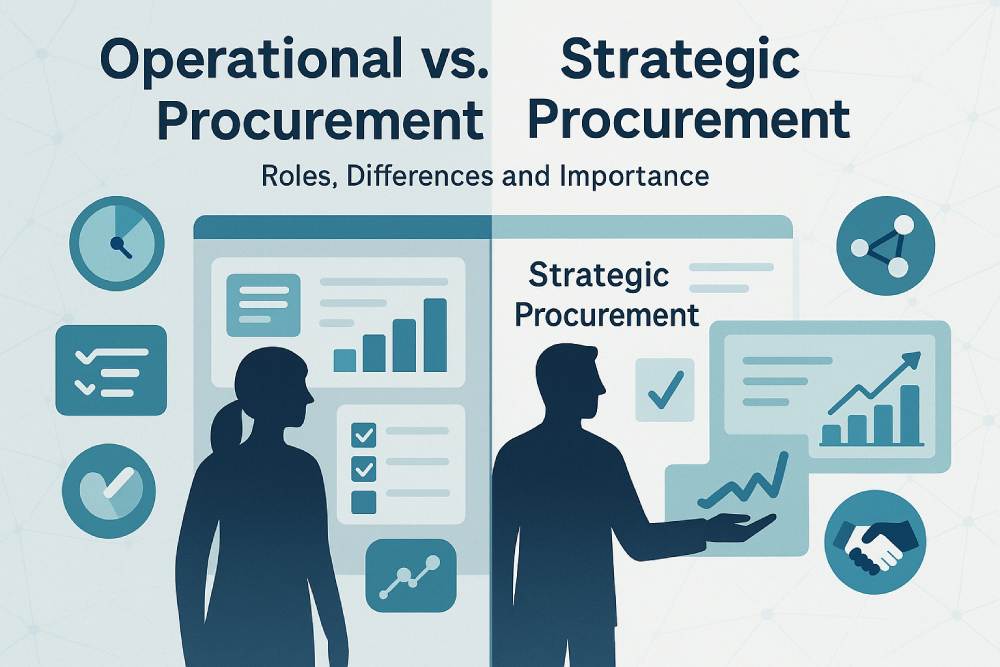
While operational procurement works in the here and now, strategic procurement takes a broader view. It shapes markets, supplier networks and processes proactively rather than reacting to developments.
Strategic procurement analyses cost drivers, assesses risks, develops supplier relationships, builds category strategies and negotiates long-term commercial frameworks. ESG standards, technological trends, compliance and digitalisation are also part of its agenda.
It is less involved in the mechanics of ordering and more focused on the structures that make these processes efficient. Its priorities are stability, competitiveness and long-term resilience – which is why its importance continues to grow.
Operational vs strategic procurement: a clear distinction
Even though both functions are closely interconnected, they pursue different goals. The differences can be explained through key questions:
What is the objective?
- Operational procurement ensures the daily business runs smoothly.
- Strategic procurement creates the conditions for future advantages.
What is the time horizon?
- Operational: short cycles, from days to weeks
- Strategic: months to several years
How do the tasks differ?
- Operational: execute, monitor, follow up
- Strategic: analyse, plan, negotiate, steer
How is success measured?
- Operational: speed, process quality, on-time delivery
- Strategic: savings, risk reduction, supplier development
These differences are not a separation in the sense of isolation – they function like two gears that must interlock.
Why both areas belong together – and how collaboration succeeds
Operational procurement cannot function without strategic guidance. At the same time, strategic planning loses value if it lacks feedback from daily operations.
Organisations perform best when both areas:
- work with shared KPIs
- have clearly defined responsibilities
- use digital tools effectively
- maintain clear escalation paths
- align their goals and priorities
For example, operational procurement provides insights into supplier reliability, process bottlenecks or changing demand patterns. Strategic procurement uses this information to refine category strategies, adjust contracts or reassess risks.
This creates a cycle of analysis, execution and improvement – the foundation of a high-performing procurement organisation.
Industry example
A machinery manufacturer experienced recurring delivery issues and rising process costs. The analysis revealed unclear distribution of strategic and operational tasks. Employees placed orders while simultaneously negotiating long-term contracts, with unclear priorities and limited transparency.
A restructuring brought clarity: roles were separated, a strategic category structure was introduced, operational processes were standardised and a shared dashboard connected both levels.
The results were clear: process costs fell by around 30%, supply disruptions decreased significantly and the team operated more confidently and cohesively.
Conclusion: The distinction is not a trend – it is a competitive advantage
Clear differentiation between operational and strategic procurement creates structure, speed and foresight. It determines efficiency, innovation capacity and supply chain stability – and ultimately the success of the organisation.
Businesses that define both areas professionally gain not only better prices or more reliable deliveries, but also a procurement function that is prepared for change and capable of leveraging new opportunities.
FAQ: Operational vs Strategic Procurement
Where does operational procurement end and strategic procurement begin?
Operational procurement manages the daily procurement process, while strategic procurement shapes markets, suppliers and long-term structures. Both overlap but require distinct roles.
Should every procurement category have a strategic owner?
Yes, if the category involves significant volume, risk or complexity. A lead buyer increases transparency and coordination.
Can small procurement teams manage both roles?
Yes – if priorities are clear. A hybrid model works well when roles are defined and responsibilities do not blur.
What role do KPIs play between the two areas?
Shared KPIs connect strategy and operations – such as price variance, on-time delivery or process costs.Why is the distinction more important today?
Because markets have become more volatile and operational efficiency alone is no longer sufficient. Without strategic direction, the risk of supply issues and unnecessary costs increases.