



Introduction
When delivery dates slip, prices rise unexpectedly or quality problems escalate, the cause is rarely only the supplier.
In many cases, there is no clear structure in supplier management.
This quickly becomes visible in day-to-day operations:
- suppliers are selected once and then hardly actively controlled
- evaluations exist – but have no consequences
- strategic discussions rarely take place
And this is exactly where the real problem arises.
Not with the supplier, but in the control.
The result is familiar:
- operational escalations
- rising costs
- a lack of transparency
- high dependencies
The decisive question is therefore:
How must supplier management be structured so that companies can actively control risks and measurably improve the performance of their suppliers?
The answer does not lie in tools or checklists.
It lies in structure, clarity and consistent leadership.
What is Supplier Management – and Why Is It Crucial?
Anyone asking “what is supplier management” often receives a simple answer: the selection, evaluation and development of suppliers.
Formally correct. In practice, too limited.
Supplier management means actively controlling your own supplier base.
Not merely reacting, but deliberately exerting influence.
Because this is precisely where a large part of value creation takes place:
- costs are not only negotiated, but structurally influenced
- risks do not arise suddenly, but develop over time
- quality and innovation often come directly from the supplier base
Companies that do not actively control their suppliers leave central levers to chance.
The 4 Pillars of Effective Supplier Management
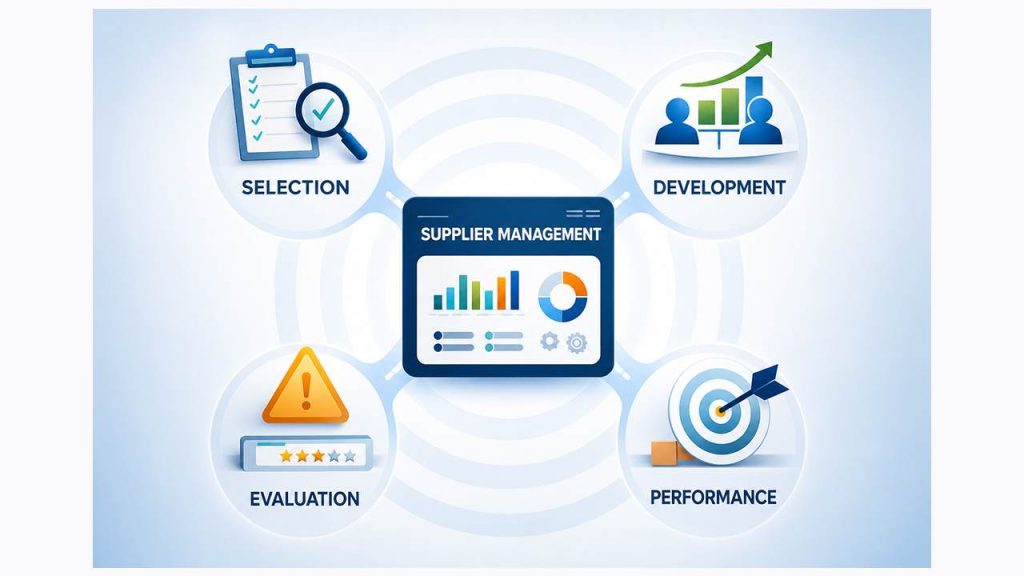
Effective supplier management is based on four clear elements:
- selection
- evaluation
- development
- control
Many companies have individual building blocks.
What is missing is the interaction between them:
- selection determines the starting point
- evaluation creates transparency
- development unlocks potential
- control ensures consequence
Only when these four elements work together does real impact emerge.
Supplier Selection: Decisions with Long-Term Impact
The selection of suppliers is not an administrative step.
It is a strategic decision.
Mistakes in supplier selection often have an impact for years.
This is not just about price and quality.
In practice, other factors are often more decisive:
- delivery reliability and stability
- scalability and flexibility
- technical understanding
- risk profile and dependencies
A simple checklist is not sufficient here.
What matters is clarity about what is truly relevant to your own business model.
Supplier selection is not the end point.
It is the starting point for everything that follows.
Supplier Evaluation: Creating Transparency – and Using It
Many companies evaluate their suppliers.
Very few use this to actively control them.
Evaluations are created, filed away – and lose their effect.
The problem is not the evaluation.
The problem is the lack of consequence.
An effective system makes performance visible and comparable:
- quality
- delivery performance
- cost development
- collaboration
More important than the number of KPIs is their binding nature.
An evaluation without consequence is worthless.
Only when results are translated into decisions does control emerge.
Supplier Development: The Underestimated Lever
Supplier development is the part that is most often missing.
In daily business, there is no time.
Discussions take place – but usually only when problems arise.
Yet this is precisely where a decisive lever lies.
Good suppliers are not found. They are developed.
This does not mean supporting every supplier.
It means consciously distinguishing between:
- strategically relevant suppliers
- replaceable suppliers
Only those who differentiate can invest in a targeted way.
In practice, this means:
- clear expectations
- regular discussions
- shared target images
Partnership does not arise through closeness, but through performance.
Supplier Risk Management: Recognising Problems Before They Arise
Risks in supplier management are rarely surprising.
They are simply often recognised too late.
Typical risks are well known:
- delivery failures
- quality problems
- financial instability
- geopolitical dependencies
Many companies only react in a crisis.
By then, it is too late.
Active supplier risk management works differently:
- identify critical dependencies early
- build alternatives
- regularly challenge structures
Efficiency without protection is not an advantage – it is a risk.
This is becoming increasingly relevant, particularly in the context of supply chain management.
KPIs in Supplier Management: Measure Less, Control Better
Many procurement organisations measure a lot.
But they control very little.
The reason is simple: KPIs are reported, but not used.
Figures without consequence do not create control.
A few clear KPIs are significantly more effective:
- delivery reliability
- quality indicators
- cost development
- response times
What matters is not the figure itself – but the decision that follows from it.
Good KPIs lead to action. Poor ones only lead to reporting.
Typical Mistakes in Supplier Management
In practice, similar patterns appear again and again:
- suppliers are not actively controlled after selection
- evaluations exist, but have no consequences
- strategic topics get lost in day-to-day business
- all suppliers are treated the same
- responsibility is not clearly defined
The result: high effort, low impact.
Supplier management rarely fails because of a lack of knowledge.
It fails because of a lack of structure and consequence.
Embedding Supplier Management in Strategic Procurement
Supplier management is not a secondary task.
It is a central component of procurement strategy.
Nevertheless, it is often simply “done alongside everything else”.
Strategic buyers are tied up in day-to-day operations.
Suppliers are administered – not controlled.
This is exactly where the lever lies.
Effective supplier management requires:
- clear responsibilities
- deliberately planned time
- measurable objectives
Only then does the transition from reaction to control emerge.
Conclusion
The guiding question was:
How must supplier management be structured in order to reduce risks and improve performance?
The answer is clear:
Supplier management works when it is led in a structured way.
Not as a tool.
Not as a process on paper.
But as a consistent management task.
Companies that implement this:
- reduce risks
- increase security of supply
- measurably improve their performance
The difference is not the system.
It is the leadership.
Unclear evaluation systems, a lack of consequence and operational escalations rarely arise from the supplier alone. In a no-obligation initial consultation, we will look at your supplier management together and assess where selection, evaluation, development and control can be set up more effectively.
FAQ on Supplier Management
What are the objectives of supplier management?
To control costs, reduce risks, secure supply and develop high-performing suppliers.
Which tasks does supplier management include?
The selection, evaluation, development and control of suppliers.
How does a supplier management process work?
As an end-to-end system of selection, evaluation, development and consistent control.
Which criteria are important in supplier selection?
Quality, costs, delivery capability, risk and strategic fit.
Why is supplier evaluation important?
Because it creates transparency and enables well-founded decisions.
What is sustainable supplier management?
An approach that considers environmental, social and governance aspects alongside costs.