


Supply chains have not only come under pressure recently. What is new, however, is how persistent this pressure has become. For procurement, this means that supplier management in 2026 is no longer an administrative side process, but a genuine leadership responsibility.
In the past, it was often enough to evaluate suppliers based on price, quality and delivery reliability. That was never wrong. It was simply incomplete. Today, procurement leaders also need to know which suppliers are critical, which risks are hidden within the supply chain and how quickly the company can respond if a supplier fails.
This is exactly where professional supplier management becomes a strategic lever. It does not only protect against bottlenecks. It also helps manage costs more reliably, reduce dependencies and make security of supply in procurement more robust.
In short: if you do not know your supplier base, you do not know your risk. And in procurement in 2026, that is a rather expensive knowledge gap.
Why Supply Chains Will Remain Under Pressure in 2026
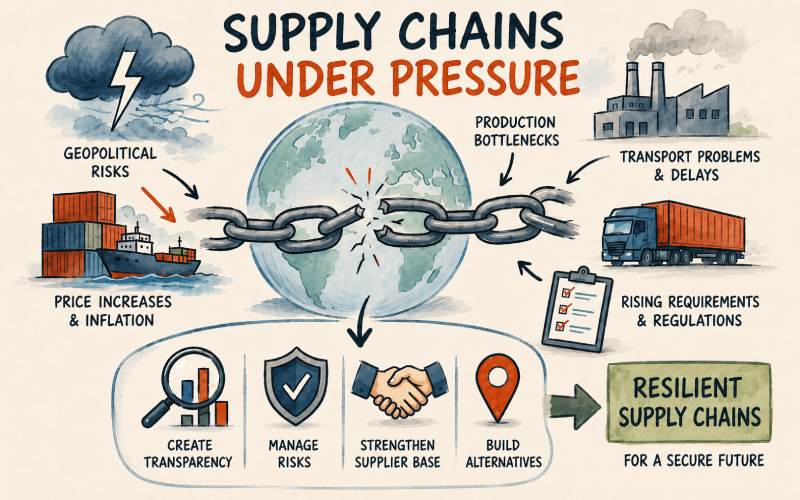
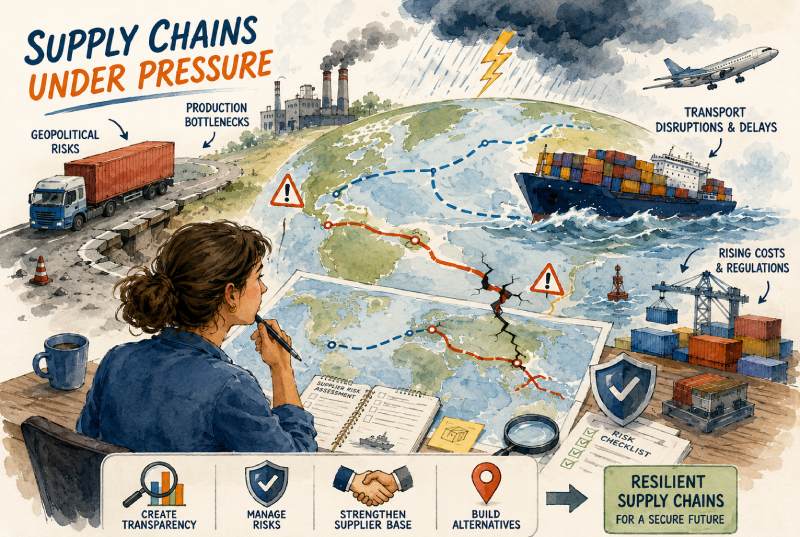
Supply chains remain vulnerable because companies have to deal with geopolitical risks, rising costs, trade conflicts, energy prices, transport uncertainty and regulatory requirements all at once.
That may sound like the big global picture. And it is. But in procurement, it lands very concretely on the table: delivery dates are postponed, prices change, alternatives are missing, materials become scarce or suppliers are unable to keep their promises.
Current industry figures show that this development is not merely a theoretical risk. The BDI continues to describe German supply chains as vulnerable: 92% of companies report higher resilience costs, while 68% are planning to relocate production abroad. The DIHK also makes clear that international supply chain disruptions are placing a noticeable burden on German industry: according to its flash survey, one in ten industrial companies is restricting production as a result, while two in five companies are postponing projects or investments.
For procurement leaders, this means that purely reactive approaches are no longer enough. Those who wait until the bottleneck becomes visible are usually already in crisis mode. Professional supplier management starts earlier.
What Supplier Management Needs to Deliver Today
Supplier management should create transparency, make risks visible and actively steer supplier relationships. It is not just about managing suppliers administratively, but about deciding which suppliers are truly strategically important for the company.
Good supplier management answers three simple questions. Simple does not mean easy.
First: which suppliers are critical for costs, quality and delivery capability?
Second: which risks exist with these suppliers?
Third: which measures reduce these risks without creating new problems?
This turns supplier management into an interface between strategic procurement, operational sourcing, quality management, logistics and senior management. This connection is particularly important in manufacturing companies. A supplier is not just an address in the ERP system. In some cases, they can determine whether a company can produce, deliver and invoice.
Strategic and Operational Supplier Management: Where the Difference Lies
Operational supplier management keeps daily business running. Strategic supplier management decides how the supplier base should be developed over the long term.
Operational procurement is often the first to notice where things are starting to creak: delivery delays, queries, quality issues, price changes, communication problems. This information is valuable. But it must not disappear into day-to-day operations.
Strategic supplier management takes these signals and assesses them in a broader context. Is this an isolated incident or a pattern? Is the supplier fundamentally capable? Are there alternatives? Does the category need to be reassessed? Is a different contract structure required, or targeted supplier development?
This is where the difference lies. Operational supplier management responds to specific events. Strategic supplier management shapes the supplier structure so that fewer critical events arise in the first place.
Both need each other. If strategic and operational procurement are not properly connected, companies end up with attractive strategies on one side and daily firefighting on the other. In the long run, that is neither efficient nor particularly good for anyone’s nerves.
Supply Chain Risk Management: Identify Risks Earlier, Not Explain Them Later
Supply chain risk management, or SCRM, means systematically identifying, assessing and managing risks within the supply chain. In procurement, this is not a theoretical discipline, but very practical damage limitation — ideally before the damage occurs.
Typical supplier risks include financial instability, single sourcing, regional dependencies, quality problems, capacity bottlenecks, long replenishment times or weak communication. Cyber risks and compliance issues are also becoming increasingly relevant.
The decisive factor is evaluation. Not every supplier with a high purchasing volume is automatically critical. And not every small supplier is unimportant. Sometimes an entire production process depends on a component that barely stands out in terms of purchasing volume. These are exactly the kinds of cases that make supply chain risk management necessary.
A good starting point is the combination of ABC analysis and risk assessment. The ABC analysis shows which suppliers or categories are particularly relevant economically. The risk assessment shows where the probability and impact of failure are high. Only together do they create a realistic picture.
And yes: this work is not glamorous. But it is often more effective than the next major strategy workshop with a lot of coffee and very little implementation.
Identifying Critical Suppliers: Not Every Important Supplier Is Critical
A critical supplier is a supplier whose failure would have a noticeable impact on production, delivery capability, quality or costs. The decisive factor is not only purchasing volume, but replaceability.
A supplier may be critical if there is no short-term alternative, if approvals take a long time, if technical specifications are very narrow or if the supplier is responsible for a central category. Suppliers with specialist knowledge, tooling dependencies or customer-specific materials can also be critical.
This distinction is important for procurement leaders. Treating all suppliers equally wastes attention. Looking only at volume means overlooking risks.
A clearer approach is segmentation:
strategic suppliers with high importance and high dependency
high-performing standard suppliers with good replaceability
risk suppliers with weak performance or high uncertainty
development suppliers with potential but not yet stable performance
This segmentation makes supplier management controllable. Only then can procurement decide where closer collaboration, alternative sourcing, development or escalation makes sense.
The Supplier Management Process: Less Bureaucracy, More Control
A supplier management process does not need to be complicated. It needs to work.
In practice, the process consists of five steps: identifying, evaluating, segmenting, developing and regularly reviewing suppliers. The problem is rarely that companies do not know the process. The problem is more often that the process is not consistently lived.
Suppliers are evaluated once, but not reassessed regularly. Risks are documented, but not translated into measures. KPIs are collected, but not used. Or the supplier management system is maintained without creating real control.
The objective is not more documentation. The objective is better decision-making.
An effective supplier management process should therefore clearly answer:
- Which suppliers are evaluated and how often?
- Which KPIs are relevant?
- Who is responsible?
- When does escalation take place?
- Which measures follow poor evaluations?
- Which suppliers should be developed, replaced or more closely integrated?
If these questions are not answered, supplier management often remains a form-filling process. And forms have rarely saved a supply chain.
Supplier Management Systems: Yes to Tools, but Not as a Substitute for Strategy
A supplier management system can be very helpful. Systems such as SAP, SAP Ariba or other SRM solutions can centrally map supplier data, evaluations, documents, certificates, risks and performance KPIs.
But a tool does not solve a leadership problem.
If the criteria are unclear, master data is poorly maintained or nobody decides what follows from the evaluations, even the best supplier management system remains a nice digital filing cabinet. More modern, perhaps, but still a filing cabinet.
The benefit only emerges when system, process and responsibility work together. Supplier management needs clear data, but also clear decisions. Which suppliers are preferred? Which suppliers should be developed? Which risks does the company consciously accept? Where do alternatives need to be built?
Technology can create transparency. Leadership must draw consequences from it.
Strategic Sourcing and Category Strategy Belong Together
Supplier management does not work in isolation. It is closely connected to strategic sourcing and category strategy.
Anyone wanting to reduce supplier risks needs to know which categories are particularly critical. A category strategy helps consider procurement markets, cost levers, supplier structures and risks together. This makes it clearer which supplier relationships should be strategically expanded and where alternatives are needed.
Strategic sourcing is not only about the next tender. It is about how a company can source securely, economically and flexibly over the long term. This includes supplier development, dual sourcing, contract models, regional diversification, quality requirements and risk management.
Good supplier management is therefore never only backward-looking. It does not merely evaluate what has happened. It decides what the supplier base should look like in the future.
LkSG, CSDDD and Compliance: What Procurement Leaders Should Pay Attention to Now
The German Supply Chain Due Diligence Act remains a relevant topic for procurement. At the same time, the legal situation is evolving due to the European Corporate Sustainability Due Diligence Directive and planned adjustments.
Important for the current assessment: according to the Chamber of Industry and Commerce, the existing LkSG remains in force until the European supply chain directive CSDDD has been transposed into German law. At the same time, BAFA has suspended the review and submission of company reports under Sections 12 and 13 LkSG against the background of the planned legislative amendment. According to current information, the CSDDD must be transposed into national law by 26 July 2028.
For procurement, this means that compliance is not disappearing. It is changing.
Companies should continue to assess supplier risks transparently, document them and derive appropriate measures. Larger companies and their suppliers in particular should expect transparency, risk analysis and documentation requirements to remain relevant.
But here too, compliance should not be understood as a paper exercise. Good supplier management does not only support legal requirements. It also helps, very practically, to identify risks earlier and secure supply capability more effectively.
Sustainable Supplier Management: Relevant, but Please Keep It Pragmatic
Sustainable supplier management is now part of the standard toolkit of strategic procurement. Nevertheless, it should not be considered separately from costs, quality and security of supply.
In practice, it is about a balanced assessment: which suppliers meet requirements relating to human rights, the environment, occupational safety, quality and reliability? Where do risks exist? Where is development needed? And where is collaboration not viable in the long term?
Procurement needs to remain pragmatic here. Not every company can immediately illuminate every upstream supply chain in full. But every company can get to know its most important suppliers better, prioritise critical risks and make standards gradually more binding.
Sustainability in supplier management becomes effective when it is integrated into existing processes: supplier evaluation, risk analysis, audits, contract management, category strategy and supplier development.
As a separate project, it is often left behind. As part of procurement management, it becomes relevant.
Which Supplier Management KPIs Really Help
KPIs in supplier management should improve decisions. If they merely fill tables, they are occupational therapy.
Important KPIs include on-time delivery, quality rate, complaint rate, price development, response speed, escalation frequency, dependency, risk assessment and the proportion of critical suppliers. The development of alternative suppliers or the number of unplanned supply interruptions can also be relevant.
But not every KPI is equally important for every company. A manufacturing company with critical components needs different priorities from a service provider with standardised procurement processes.
The best KPIs are usually those that lead to decisions. If a KPI deteriorates, it must be clear what happens next. Is the supplier developed? Is an alternative sought? Is the contract adjusted? Is the issue escalated?
Without consequences, even the most attractive dashboard is only decoration.
What Procurement Leaders Should Do Now
Procurement should not start supplier management as a major project, but as a leadership responsibility with clear prioritisation.
The first step is transparency: which suppliers are truly critical? Then comes the assessment: which risks exist and how likely are they? Only after that do measures follow.
A pragmatic 90-day approach is particularly useful:
In the first 30 days, critical suppliers, categories and dependencies are made visible. In the next 30 days, risks are assessed and prioritised. After that, concrete measures should begin: checking alternatives, developing suppliers, adjusting contracts, clarifying escalation paths or redefining KPIs.
Procurement does not have to solve everything at once. That would be the surest route into overwhelm. What matters is addressing the critical topics first — those where supplier failure would cause high costs, production problems or customer risks.
Good supplier management is not a project with an end date. It is a control process. And the more unstable supply chains become, the more important this control becomes.
When External Support in Supplier Management Makes Sense
External support makes sense when supplier risks are known, but internal time, structure or leadership are lacking to address them consistently.
This happens more often than one might think. Procurement recognises problems, but daily business eats up capacity. Management expects cost reduction, but delivery capability and quality need to remain stable at the same time. Supplier evaluations exist, but nobody translates them into action.
In such situations, external support can help create structure quickly. Especially when supplier management, procurement risk management, category strategy and operational implementation are required at the same time.
An experienced interim manager or procurement consultant can identify critical suppliers, assess risks, prioritise measures and support implementation. Not as a theoretical exercise, but close to daily business.
That is exactly where the difference lies: supplier management only works when analysis becomes action.
Conclusion: Supplier Management Is No Longer an Administrative Process in 2026
Supplier management is becoming a central responsibility of strategic procurement in 2026. Companies need to know which suppliers are critical, which risks exist in the supply chain and how they can actively protect security of supply.
Procurement does not need a perfect world for this. That rarely exists anyway. It needs transparency, clear priorities, robust supplier evaluations and the willingness to turn data into real decisions.
Supply chain risk management, strategic sourcing, category strategy and supplier development belong together. Those who connect these topics properly reduce risks not only on paper, but in operational reality.
And that is what it is all about: fewer surprises, fewer firefighting missions, more control.
Support in Supplier Management
SJL Management & Consulting supports companies in making supplier risks visible, reducing critical dependencies and anchoring effective supplier management in procurement. The focus is on clear analysis, pragmatic prioritisation and operational implementation.
FAQ — Supplier Management Under Pressure
Why is supplier management particularly important in 2026?
Supply chains remain under pressure due to geopolitical risks, cost increases, regulatory requirements and volatile markets. Professional supplier management helps procurement identify risks earlier and secure supply capability more effectively.
What are critical suppliers?
Critical suppliers are suppliers whose failure would have a significant impact on production, delivery capability, quality or costs. The decisive factor is not only purchasing volume, but above all replaceability and importance for operational business.
Will there be supply chain bottlenecks?
Bottlenecks cannot be predicted across the board. What is clear, however, is that international disruptions, geopolitical conflicts, transport problems and price increases raise the risk. Procurement should therefore review critical categories and suppliers early instead of only reacting once a bottleneck occurs.
What does the 80/20 rule mean in the supply chain?
In procurement, the 80/20 rule often means that a small proportion of suppliers or categories accounts for a large proportion of purchasing volume, risks or operational importance. ABC analysis in supplier management helps make these priorities visible.
What is an unethical supply chain?
An unethical supply chain exists when human rights, social or environmental standards are violated along the supply chain — for example through forced labour, child labour, dangerous working conditions or serious environmental violations. Sustainable supplier management aims to identify, assess and reduce these risks.